Showing posts with label Captain Marvel. Show all posts

Sunday, 31 March 2024

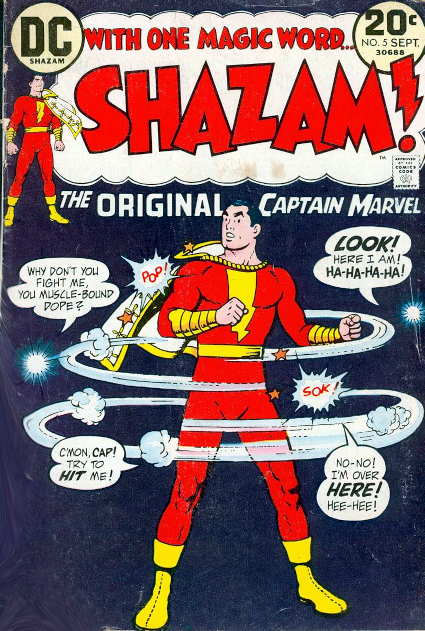
Shazam #5, the Original Captain Marvel enters my life, via a visit to the butcher's shop.

Thanks to Charlie Horse 47 and Killdumpster for their sponsorship of this post, via the magic of Patreon
***

Sazam #5, the Original Captain Marvel
If there's one thing visitors to this site can take for granted, it's that it will never be anything but topical.

And so it is that, this Easter Sunday, it can be found reviewing that most Easterly of comics.

Shazam #5.

OK, I admit it. It has nothing to do with Easter. But, who knows? Maybe we can find a little of that Easter magic contained somewhere within its pages.

I first acquired this comic in the early 1970s in a shop just beyond the city centre, before being dragged into a small butcher's shop where the elderly customers were complaining they'd never get used to this new money the government had brought in which involved having to know the ten times table, as opposed to the twelve times table.

How appropriate, then, that also concerned with money is small-time crook Slip Kelly who, in our first tale of the issue, encounters no less a dignitary than a visiting leprechaun.

Grabbing it, he claims his one wish and is granted the power of invisibility.

Shazam #5, Slip Kelly vs the horror of wet cement
With that, he robs the local bank, simply by walking out of it with a large pile of banknotes in his hands.

Fortunately for the bank - but not for Slip - clean-cut child Billy Batson just happens to be there and, quickly transforming himself into the Original Captain Marvel, sets about tackling the situation.

However, the leprechaun reveals that Slip can only be restored to visibility by cancelling his own wish.

And Original Cap knows just how to make him do it.

Shazam #5, Slip repents
He drops Slip from a great height, knowing that because he can't see him to rescue him, he has no way to prevent the crook from being splattered upon impact with the ground. Thus it is that Slip can only survive if he re-grabs the leprechaun and demands it make him visible again.

I'm not sure if I should point out that, if Slip hadn't managed to catch the leprechaun on the way down, he'd now be a huge red mess on the road and Original Cap would be facing a murder charge, lending the whole plan a far darker edge than it's, presumably, meant to have.

My main takeaway from this, the issue's first tale, is that CC Beck's art has a cartoony simplicity to it that's totally at odds with how super-hero comics were drawn at the time but has an easy-on-the-eyes charisma you can't help but like. 

Also, writer Elliot S Maggin has dropped the exclamation mark from his name. The one that I've now convinced myself he always used.

I am, though, puzzled as to why our hero's depicted with closed eyes in every single panel he appears in.

Shazam #5, Sunny Sparkles
In our second tale of the issue, Billy Batson's accompanied, on his mission to collect old periodicals for recycling, by his friend Sunny Sparkle - who, despite everything we're told about him, looks like something from a horror film - and his not so sunny cousin Rowdy. Among the material they gather on that collection is a book that tells you how to do everything.

Rowdy spots his opportunity and uses it to turn himself, instantly, into the world's toughest guy.

Shazam #5, Captain Marvel tears up the book that gives Rowdy his strength
Clearly, this can't be allowed to stand and, so, Original Cap challenges the boy to a show of strength in which our hero tears apart the book that's given Rowdy his newfound power.

And, with the book destroyed, that newfound strength becomes newlost strength and whatever slight menace Rowdy may have posed to humanity is gone.

Shazam #5, Captain Marvel Jr vs the Champ
To finish, we get a Captain Marvel Jr tale.

And this is noticeably different.

For a start, it's not drawn by CC Beck. Written by Joe Millard, it's drawn by Sheldon Moldoff and isn't a new adventure, being a reprint from 1948.

It's a big occasion for the local kids because, in the street, they spot a man who's only ever referred to as Champ who's clearly a boxer of some import.

Shazam #5, Champ the Chump
He may be a champ in the ring but, out of it, he's made of 100% rotten and nearly gets an autograph-seeking child killed by knocking him into the path of a speedy automobile.

Fortunately, local newspaper vendor Freddy Freeman's on hand to become Captain Marvel Jr who then takes Champ off to have a word with him about this behaviour, doing most of his talking with his fists.

It's then that we learn Champ's agreed to throw his next fight but, happily, a random woman walks into the room and convinces him not to, by referencing his mother and father.

Who this woman is isn't made clear in the story. But Captain Marvel Jr clearly knows her. So, I'll assume she's his housekeeper or something.

Shazam #5, Mrs Wagner lectures the Champ
Suitably shamed by her speech, Champ, with Jr's aid, quickly brings justice to the match-fixers, and Champ's a reformed character who's now even willing to talk to children.

It does leap out at you that this story has a far more serious attitude than the issue's other two, in both art and writing and does make you realise that Daredevil would never have existed had Captain Marvel Jr been around.

Overall, the book's a charming and simple read, like encountering a less demanding but cooler version of a 1970s Superman comic and, therefore, I give it the gentle Easter Sunday thumbs-up it, no doubt, deserves.

Sunday, 19 January 2020

Superman #276, Make Way For Captain Thunder!

Superman #276, Captain Thunder, the original Captain Marvel, Shazam
It's the question we've all asked; "Who'd win a fight between Superman and Captain Marvel?"

Admittedly, I never actually have. After all, the answer's blatantly obvious. How's Captain Marvel supposed to beat Superman when he's got Rick Jones griping in his ear and singing all the time?

But, of course, there was another Captain Marvel, one who never dared speak his name, for fear of the solicitors getting involved and, in 1974, he got to meet his old nemesis from the 1950s law courts, the Man of Steel.

Except he didn't, because the foe Superman tangles with in his 276th issue bears absolutely no resemblance at all to the original Captain Marvel. Seriously, no one could possibly confuse the red and white clad Captain Thunder and his youthful alter-ego Willie Fawcett with Captain Marvel and Billy Batson.

It all begins with Willie appearing, from nowhere, in a Metropolis street, just in time to see Superman flying overhead on his way to dealing with some threat or other.

Superman #276, Captain Thunder/Captain Marvel
This is all very odd, as Willie's never heard of Superman before, even though everyone else seems to recognise him.

Then, while Superman's dealing with an imaginary monster conjured up to distract him while a gang of criminals rob an armoured truck, Willie decides Captain Thunder had better tackle the gang. He rubs his belt buckle, says the magic word, "THUNDER," and, in his super-heroic guise, sets off to sort out the miscreants.

There's only one problem. No sooner has he transformed into the captain than he's stricken with an irresistible urge to help the wrongdoers!

Needless to say, this quickly brings him into conflict with Superman, in a fight which only ends when Thunder gives Supes the slip by changing back into Willie.

Superman #276, Captain Thunder vs the Monster League of Evil
Willie goes to see Clark Kent because he's told the reporter's a friend of Superman.

He tells Clark how he first became Captain Thunder and of how his last battle was with a gang of villains comprising Dracula, the Wolf Man, Frankenstein's Monster and the Mummy.

As he left the defeated fiends in a cage he'd created for them, they shouted a mysterious threat at him, one he only now understands as meaning they'd found a way to send him to the wrong dimension and turn Captain Thunder evil.

Together, boy and reporter set off to solve the mystery of just how he got here and how to get him back home.

But, before they can even start, yet another crime breaks out and Willie once more transforms himself into Captain Thunder, causing the resumption of his fight with Superman.

Superman #276, Captain Thunder/Captain Marvel
This time, the Kryptonian clobberer manages to hold on to Thunder for long enough for the out-of-sorts hero to figure out how to get back home and cure his malfeasance. With one more rub of his belt, Thunder's gone and that's that problem sorted.

So, is this the epic, no-holds barred lurch into action, destruction and chaos that Nick Cardy's cover leads us to expect?

No. Of course it isn't. It's a 1970s Superman comic. That means reading it's like putting on a comfy pair of slippers and eating some chocolate biscuits. No one is, at any point, in any peril. Despite using their most powerful blows, the two heroes totally fail to hurt each other and everything's wrapped up simply and straightforwardly with a total lack of animosity.

This makes it sound like a bad thing.

And it kind of is.

And it kind of isn't.

Superman #276, Willie Fawcett gets his powers, Captain Thunder/Captain MarvelLike all Superman tales of this era, it's appealing because Curt Swan draws it with a charm and lightness of touch few artists could match.

In fact, the main enjoyment comes not from the somewhat low-key clash between crime fighters but from spotting all the changes writer Elliot S! Maggin makes to the character of Captain Marvel, especially the retelling of his origin, this time involving a helpful owl, a cave and an elderly native American

Whether this is a good thing or a bad thing ultimately depends on your tolerance for storytelling that lacks any desire to be dramatic.

As I've said in the past, I must have a massive tolerance for the dramatically unambitious because, as a youth, I probably had more Superman comics than books starring any other costumed American hero, and something must have been making me come back for more.

Sunday, 29 April 2018

Captain Marvel makes his debut - Marvel Super-Heroes #12.

With The new Avengers movie currently thrilling super-hero fans everywhere, it can only mean one thing.

That it's time for me to take a look at Captain Marvel's first appearance, in the pages of Marvel Super-Heroes #12, way back in 1967.

Admittedly, I can't see any link at all between those two things either but that won't stop me pretending there is one, in order to give me an excuse to do this post.

What happens is this. Upset that the FF have flattened the Sentry and Ronan the Accuser, the Kree upper echelons have decided to send Captain Mar-Vell to Earth, so he might succeed where his two predecessors failed, and teach the Earthmen not to mess with the Kree.

The only problem is that, the moment he lands, radiation from his suit causes a desert rocket launch to blow up, alerting the authorities to his presence.

Fortunately, our villain escapes by shooting the pursuing guards, with a black light beam fired from, "The galaxy's most common all-purpose weapon," before hitching a lift into town and checking into an hotel, under the name, "Marvel." It's explained that he can't sign in under his real name because that'd tip the hotelier off that he's an alien. To be honest, if I were an hotelier and someone called, "Mar-Vell," checked in, I'd just assume he had an unusual name. Clearly, other hoteliers are made of more paranoid stuff.

Sadly, we don't learn what fake first name he uses. I assume he doesn't check in as, "Captain Marvel," because that really would raise suspicions.

But, now, alone in his hotel room, Mar-Vell watches the skies and contemplates the mission ahead of him.

The first thing that strikes you about this tale is that it screams, "Stan Lee," at you. Right from the start, Lee gives us a love triangle of the kind he often seemed obsessed with. On the very first page, we learn that the beauteous but lachrymose Medic Una is in love with Mar-Vell but their commanding officer, the treacherous Colonel Yon-Rogg, wants her for himself and is thus out to make sure that Mar-Vell doesn't return alive from his mission.

Another Lee staple that quickly rears its head is that of the fatal weakness. We rapidly learn that, for all his aptitude, Mar-Vell has an Achilles heel - or, in his case, Achilles lung - because  he can't breathe the Earth's atmosphere and live. Because of this, he must drink a steaming potion that will allow him to breathe without his helmet for just one hour. Why do I get the feeling that future issues are going to involve him getting separated from his helmet on a regular basis?

Other than Stan the Man's typical foibles, the main thought that enters my head is that everything about the tale seems remarkably vague. At the beginning, it seems that Mar-Vell is being assigned to Earth by Yon-Rogg because Yon-Rogg wants to get rid of him but, then, later in the tale, we're told he's here under the orders of the Supreme Intelligence. We're told he's been sent here to punish us but it's not clear in what way he's supposed to punish us or when or how.

When he gets to Earth, he seems to have been dropped off at a random spot, with no plan and, from that point on, is clearly winging it. I don't get the feeling the Kree put a lot of thought into this mission.

You also wonder why, after a Sentry and Ronan have failed, a humble captain is now being sent to sort out the humans. You would have thought the loss of two such powerful figures would have convinced the Kree that they should be upping the ante and not downing it.

Anyway, it's difficult to draw too many conclusions about the good captain's potential from this tale, as it's only just over a dozen pages long and seems more interested in setting up the love triangle than anything else. Gene Colan's art is fine but I've never been convinced that sci-fi was his strong point. His hi-tech always looked a bit retro, even in the 1960s. Lee's script, meanwhile, is far too soapy and filled with what feels like teen-angst.

All in all, on the strength of it, you'd fail to be hooked but, with its promise of interplanetary espionage, you do at least feel there may be some good reason to get the next issue.

A final thought that does strike me, though. In the desert, the radiation from Mar-Vell's suit is enough to make a rocket blow up, from several hundred feet away. Just how much radiation is he giving off and how is he still alive?

Sunday, 31 December 2017

Captain Marvel #17. How to become a better man, in just three easy steps.

Captain Marvel #17
It's New Year's Eve and we all know what happens on New Year's Eve.

I spend all evening complaining about fireworks going off and then complaining when they're over.

Some people are never pleased.

But another thing happens on this night.

And that's that we make all kinds of promises to become better people.

Needless to say, we all have the good sense to not get anywhere near keeping those promises but such a state of affairs does mean it's an ideal time to look at a man who did indeed once manage to become a better man.

And that man is Captain Marvel because, less than twenty issues after his comic was launched, the hero created purely for legal reasons was drastically reinvented in an attempt to make him more viable. And issue #17 is where the bulk of that reinvention occurred.

What happens is this.

Captain Marvel #17, Rick Jones and an alien cave
Rick Jones is keeping up the habit of a lifetime by roaming around feeling sorry for himself because no super-heroes want anything to do with him. The Hulk tried to bump him off the last time they met and now Captain America has given him the brush-off.

Admittedly, it's not really Captain America. It's the Red Skull pretending to be Captain America but Richard isn't aware of that and so does what anyone would in his position. He hitches a lift to the middle of nowhere and then follows a glowing copy of Cap into a cavern clearly created by aliens, before putting some strange-looking bands on his wrists.

I have to confess that, personally, I wouldn't do any of those things, as all of those things are clearly stupid things to do.

Fortunately, Rick Jones isn't made of what I'm made of. He's made of one hundred percent stupid. This is a boy who once drove his car into a nuclear testing site, just as a bomb was about to go off, and then sat there playing his mouth organ. For him, chasing glowing figures into alien caves and sticking ominous things on his wrists is just another day at the office.

Captain Marvel #17, Rick Jones swaps bodies
So it is that, no sooner has he banged the bracelets together, for no good reason, than he's swapped places with Captain Marvel who instantly finds himself under attack by the villainous Yon-Rogg who tries to blow him up with a robot duplicate of Carol Danvers before fleeing in his spaceship.

All that drama done with, Rick is returned to this world, from the Negative Zone and stalks off, declaring that he's going to hunt Yon-Rogg down and give him a good slapping.

It's all a very strange thing. Obviously, given that his early adventures were not exactly stellar, it made sense to reinvent Mar-Vell by giving him a new costume and powers, such as enhanced strength and the power of flight but it's a bit hard to see in what way the strip benefits from our hero having to keep swapping  places with Rick Jones every time there's trouble.

Obviously, writer Roy Thomas did it as an homage to the Original Captain Marvel and his constant place-swapping with Billy Batson but it still doesn't change the fact that it's effectively turned the comic's star into Rick Jones's sidekick, a fate that surely no hero deserves. The Captain being stuck alone in the middle of nowhere for half of every issue also severely limits his possibilities for character development.

Captain Marvel #17, Rick Jones is on a quest
At least the one saving grace is that Rick doesn't sing in this issue. It is weird how you can hate Rick Jones's singing, despite never having actually heard him do it.

Personally, I would have thought the obvious way to improve Captain Marvel would have been to have left him pretty much as he was, but with the new costume and the souped-up powers and then let him have adventures in outer space, rather than on Earth.

It does always seem strange to me that Stan Lee launched two comics in the late 1960s that featured space-born heroes - Captain Marvel and the Silver Surfer - and then had them both mostly limited to operating on Earth. You can't help feeling their potential wasn't really being fully exploited and, given his normal shrewdness as an editor, it does seem a strange blind spot on Lee's part.

The story itself is fairly straightforward, its first half there to set up Jones' meeting with Marvel and its second being there to give the Kree captain a chance to discover what new powers he has. As a result, it's lively but a bit insubstantial. On the art front, it's stylishly drawn by Gil Kane although it's not, I think, his very best work.

While merging Marvel with Jones never really made sense from a story-telling standpoint, I suppose it did at least make the finale of the Kree/Skrull War possible, so at least some good came out of it.

Anyway, those are my thoughts on the futility of self-improvement. You might have more noble ideas. Either way, have a Happy New Year and don't run into any caves. You never know what might be lurking in them.

Thursday, 12 December 2013

This week, I have mostly been reading...

As you no doubt know, this blog ploughs through millions of comics every day in order to bring you opinions so powerful they could rock the world. Why, grown men themselves have been known to hide in cupboards to avoid the power of my fulminations.

But the truth is that even I don't always have strong enough feelings about a comic to bother reviewing it in full. Therefore, this is a selection of what I've been looking at lately that I can't bring myself to give a full write-up to.

Avengers #2, The Space Phantom

The Avengers have their second outing and find themselves up against the Space Phantom who, for years, I always got mixed up with the Space Parasite.

Needless to say, in this tale, everyone gets everyone mixed up with the Space Phantom and by the end of it all, the Hulk's quit and the newly formed group are already a man down.
Avengers #3, Sub-Mariner

Just to make things worse for our heroes, not only are they a man short but the very next issue, they have to fight both him and the Sub-Mariner.
Avengers #4, Captain America returns from the dead

Bah! Who needs that pesky Hulk anyway? Thanks to the maturity levels that only Namor can supply, the Avengers return to full strength with the return of Captain America.
Batman #265, Batman Greatest Failure

Batman has  his greatest failure!

Or perhaps he doesn't, as he encounters murder on a film set.

This is actually one of my favourite Batman tales from the era but I don't have anything to say about it that I haven't said about other Batman tales in other posts, therefore I shall not review it but merely express my liking for it.
Captain Marvel #29, Cap goes Cosmic

Captain Marvel goes all cosmic and has his head redrawn by John Romita.

To be honest I've never been totally sure what Cosmic Awareness is but it's all good mythic stuff as Jim Starlin's Cosmic Cube saga rumbles on and we get some back-story for the solar system.
Captain Marvel #50, Super Adaptoid

Jim Starlin's long-gone but Mar-Vell's Cosmic Awareness comes in handy as he uses it to beat the Super-Adaptoid and bring Rick Jones permanently back to our world.

Tragically, this means we shall have to endure more of Rick's singing career which mostly seems to consist of him declaring himself not to be John Denver.

I can confirm that I too am not John Denver.
Ka-Zar #6, Moby Dick

Ka-Zar finds himself in a Savage Land re-enactment of Moby Dick as he helps a vengeance-seeking wally try to kill a giant river monster.

The story's concept might be pretty clichéd but it's beautifully drawn by Alfredo Alcala.
Mighty World of Marvel Annual  1979

It's the Mighty World of Marvel but it might as well be called Daredevil Annual 1979, as our red clad hero finds himself in two tales.

The first is a very long but uninvolving team-up with the Black Panther. The second is shorter and stronger as the man without fear finds himself on a train, up against the Beetle and the Gladiator.

Friday, 18 February 2011

Horizontal heroics from a long-gone landscape. The Titans #1.

Marvel UK, The Titans #1
Has there ever been a greater comic book cover than that of Marvel UK's The Titans #1? What kind of comics fan could resist the sight of all those heroes rushing out of the page at him?

Of course, the other thing that leapt out at you when you first saw The Titans was that it was printed the wrong way up. Surely such a thing was madness but it was also genius, allowing twice as much content at no extra cost.

Admittedly, not all those heroes on the cover could exactly be called easily recognisable. Just who is, for instance, that blue man with the pointy ears behind Nick Fury?

But, if the cover wasn't packed entirely with what you could call Marvel "A" Listers, it was at least a reflection of the mag's not-always Top Line content as the issue kicked off with the Inhumans in a tale written as well as drawn by Jack Kirby, which means the dialogue's often made up of people just describing what's happening and we get a silly plot by Maximus the Mad to start a war between the Inhumans and humans by making the former think the Fantastic Four are firing missiles at them. The Inhuman Royal Family, having seemingly had lobotomies, all fall for this cunning ruse and, within mere pages, Black Bolt's all ready to declare war.

If the Inhumans are ready to launch into conflict, the next story starts in the thick of one as we get Stan Lee and Jack Kirby's 1960s retelling of Captain America's origin. At just ten pages, it can only be seen as a master class in compression - although it does bring home Captain America's irresponsibility in making a young boy his accomplice on deadly missions and it does beg the question as to why Captain America - who was presumably a captain - spent most of the war pretending to be a private instead of just being Captain America.

From one World War Two veteran to another as we're then given the first half of Nick Fury's first-ever adventure as Agent of SHIELD. It's not exactly a secret that I'm somewhat allergic to both Nick Fury and SHIELD but the story does at least feature a flying car, so it has something to appeal to me.

Next we get the issue's only real clunker as Stan Lee and Gene Colan give us the start of a Sub-Mariner epic in which Namor returns to Atlantis only to discover Warlord Krang has claimed the throne of Atlantis in his absence. It'd be easy to say one's outraged by this villainous behaviour but the truth is Namor acts like such a complete jerk in virtually every panel that when Krang has him flung into a cage to rot, you're hoping he spends the rest of eternity there. Sadly, Lady Dorma - who betrayed Namor to Krang in an attempt to win Namor's heart - then helps him to escape in order to try and win his heart. Those Stan Lee scripted women, eh?

Captain Marvel too finds himself threatened by a menace that arrives from underwater as he faces the Metazoid, a Soviet dissident who, exposed to experimental rays, has become a strange inhuman creature. The Metazoid's been told by his masters that if he kidnaps Mar-Vell's alter-ego - rocket scientist Walt Lawson - they'll restore him to normal. The tale's dominated by the Metazoid's struggles with his conscience and endless philosophising as he tries to work out whether he can justify kidnapping a man to return himself to normal. Surprisingly the haunted nature of the Metazoid makes the Captain Marvel tale the best story in the issue, marred only by the fact that some of the pages are printed out of order. Was this a consequence of the printers struggling to make sense of the new format or was it just one of those things that happens?

Throw in a John Buscema poster featuring a whole host of Marvel super-doers, and a plug for that year's Marvel annuals and there you have it; as far as I know, Britain's - and possibly the world's - first ever landscape format comic. I can't deny it, the format and the five stories per issue always made The Titans feel like something special to me. There was also something that appealed about the unpredictability of just what strips were going to be in it that week.

Have there been any comics since The Titans and Super Spider-Man that were printed in landscape format? It's a shame if there haven't because it was an ingenious idea and, when my destiny's finally fulfilled and I hold ownership of the American comic book industry in my talons, then the world had better beware, for I shall make sure the landscape format returns to once more bamboozle printers and newsagents alike.

Tuesday, 5 October 2010

Mighty World of Marvel annual 1978.

Mighty World of Marvel Annual 1978, Captain Marvel and Luke Cage, hero for hireI suppose it’s a sign of how far Marvel UK’s flagship title Mighty World of Marvel had drifted away from its roots that the 1978 annual of that name doesn’t feature any of the characters you actually associate with it.

By then, in the weekly mags, Spider-Man was long gone and the Fantastic Four’d been shunted around all over the place, having been moved to The Titans then to Captain Britain then to their own comic before eventually heading back to The Mighty World of Marvel. On top of that, the likes of Conan, Dracula, Sgt Fury, the Avengers, X-Men and even Planet of the Apes had had their spells in the comic.

And so it is that, despite the cover showing long-standing Mighty World of Marvel favourites Daredevil and the Hulk, inside we get Captain Marvel and Luke Cage.

The 1978 annual gives us just two tales. In the first, Captain Marvel - having been trapped in the Negative Zone - gets to swap atoms with Rick Jones so they can take each other’s place in this world.

I’ve never really been sure why the decision was made to bring together Rick Jones and Captain Marvel. They don’t seem a natural fit and I’m not sure the strip really gained anything from it. It’s easy to see why Captain Marvel’s there but not why Rick Jones is. Maybe it was just Roy Thomas trying to find a new use for a character who’d tended to be a spare cog wherever he’d shown up or maybe it was him trying to emulate the Billy Batson/Original Captain Marvel set-up. Either way it meant Jones was now a spare cog actively built into the structure of a comic rather than just being tacked on which maybe gave him a greater sense of importance but also gave him a greater potential to be an irritant.

Still, it’s an atmospheric tale as stylishly drawn as ever by Gil Kane, though let down towards its climax by the appearance of a dull villain in the shape of the murderous Yon-Rogg. There’s also an exploding Carol Danvers, an idea the less said about which the better.

In the second tale, Luke Cage goes to Japan where he encounters a megalomaniac with a base in a volcano. I think we can guess which movie Chris Claremont’d been watching before he came up with this tale and it does indeed feel suspiciously like a James Bond flick as Moses Magnum tries to drill to the Earth’s core, paying no heed to the fact it’ll set off a series of earthquakes that’ll destroy large chunks of the globe.

Exactly why he wants to do this isn’t clear. Apparently he wants to get his hands on the magma so he’ll be rich. Maybe it’s me but I wasn’t aware of any major global trade in magma. I’m also not convinced the market for it’ll be all that great if half the world - and its economy - has just been destroyed.

In truth it’s a tale that doesn’t really make a lot of sense all round. It’s hard to see why Magnum’s doing what he’s doing at any point in the tale, nor where the character Sam Sheridan, who’s some sort of seismologist/geologist, fits into it all. One moment Magnum wants her alive, then he wants her dead. One moment he wants her advice on how safe what he’s doing is, the next he’s totally ignoring that advice.

In the end, none of it matters as Magnum’s killed when his drilling laser causes his volcano base to blow up, meaning Luke Cage never actually needed to have turned up in the first place. It’s quite a long tale but rarely an interesting one and I do have the problem that Cage is written in such a way that, whenever I read his dialogue, I hear him speaking with the voice of Hong Kong Phooey.

This was the last UK Marvel annual I ever had. After reading it I decided that if it didn’t have the big-hitters like the Hulk and the FF, and only had two stories, it just wasn’t worth bothering with anymore. It’s a shame because, like a lot of people my age, Mighty World of Marvel had been my main inculcation into the ways of Marvel. The weekly comic itself still had some life in it but, not much more than a year later, Dez Skinn’s editorship made that too a shadow of its former self. Maybe the 1978 Mighty World of Marvel annual at least did us that service of preparing us psychologically for the once-unthinkable time when Marvel UK’s greatest title was no longer worth buying.