Showing posts with label Marvel Annual. Show all posts

Sunday, 24 December 2023

Fifty Years Ago Today! The 1973 Marvel UK annuals for 1974.

Thanks to Charlie Horse 47 and Killdumpster for their sponsorship of this post, via the magic of Patreon
***

Yo-ho-ho, boys and girls. I hope you've all been good, this year, because it's the very Eve of Christmas itself!

And that means we're all going to be finding a very special something in our stockings.

Nothing less than 1973's Marvel Annual 1974!

But that can wait. First, we need to discover just what were we watching on Christmas Day of that year.

That morning, BBC One turned its back on wokeness and gave us the spectacle that was its Black and White Minstrel Show. I'm kind of feeling it won't be repeating that one this Yuletide.

In the early afternoon, we were treated to the Festive Top of the Pops in which Tony Blackburn and Noel Edmonds fronted a special edition of the nation's favourite music show. That meant we got the biggest hits from such stars as Suzi Quatro, Slade, the Simon Park Orchestra, 10cc, Peters & Lee, Wizzard, Dawn and David Cassidy.

And, of course, it was all visually supplemented by the permanently traumatising never-to-be-forgotten dance moves of Pan's People.

Later, we got Billy Smart's Christmas Circus, Christmas Pantomime: Robin Hood, Bruce Forsyth's the Generation Game, The Mike Yarwood Christmas Show, The Morecambe and Wise Show and The Odd Couple.

And, because it was that time of year, we ended the day with Lost Hearts, one of the BBC's legendary Ghost Stories for Christmas. In this one, an orphan goes to live with his uncle but finds himself haunted by the ghosts of two children.

Tragically, despite my love of Christmas ghost stories, I missed it.

However, I had a very good reason to do so.

One that has shaped my mind to this very day.

Over on BBC Two, the morning offered us White Christmas before we were treated to a cartoon version of A Christmas Carol followed by Far From the Madding Crowd, Buster Keaton's The Railrodder, Swan Lake and Alice Through the Looking-Glass.

However, all of that paled into insignificance next to what the day's schedule ended with.

And that was Quatermass and the Pit!

And that broadcast is why I missed the ghost story on BBC One. And it's why I shall always associate Christmas with a man plunging a tower crane into the heart of Satan.

But what of ITV?

The commercial behemoth treated us to an episode of Rainbow before offering up Chipperfield's Christmas Circus.

The Afternoon Movie was Where Angels Go, Trouble Follows. A film I've never heard of in my entire life.

Then we got Queen of Hearts with Danny La Rue and Peggy Mount.

That was followed by All-Star Comedy Carnival which appears to have been a Jimmy Tarbuck-hosted compilation comprised of Man About the House, My Good Woman, Sez Les, Billy Liar, Spring and Autumn and Doctor in Charge. I must confess that My Good Woman and Spring and Autumn are totally unfamiliar to me.

After that, we got Tommy Cooper's Christmas, Von Ryan's Express and, if we lived in Yorkshire, The Odd Couple. This means the BBC and ITV were both showing The Odd Couple, that evening. However, the former was showing the movie, while the latter was offering us the TV spin-off.
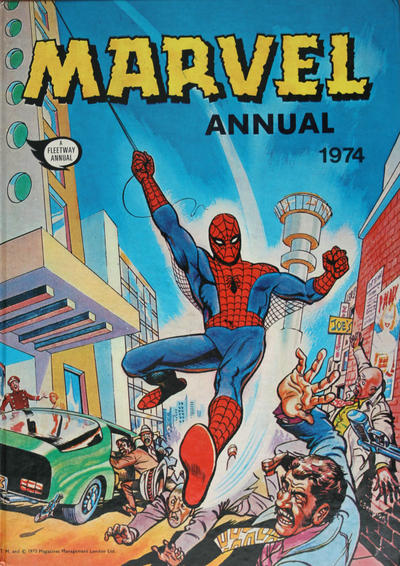
Marvel Annual 1974

Hooray! It's the sequel to the classic 1973 Marvel Annual. And I have to say its cover's not a patch on its predecessor's 

Opening it up, the inside seems far less themed than that had been. All but one of the stories in its forebear were from the very early days of the 1960s, with three of the tales featuring our heroes vs alien menaces.

This year's selection of tales seems far more arbitrary.

We kick off with On Wings of Death! the tale in which the Beetle abducts Aunt May, and Spidey has to confront him in a swimming pool.

Then we get The Origin of Daredevil.

That's followed by something called The Star Raiders, a Lee/Ditko intriguer in which a group of convicts-turned-pirates are tricked into attacking a planet they believe defenceless. Only for them to discover the inhabitants are not the midgets they thought they were!

Next, is the aquatic drama of When Attuma Strikes! When Hank Pym snaps at the Wasp for making a mistake during an experiment, she flees. But, when her plane's captured in Attuma's latest bid for world conquest, only Giant-Man can save her.

For those who've not got enough of Giant-Man from that tale, we then get Special Feature: All You Want to Know About Giant-Man. To be honest, I'm not sure there's that much I want to know about Giant-Man but it's nice to know the info's there, should I ever need it.

Leaving the man of size behind, we stumble across And Then Came Electro! in which Spider-Man agrees to guest on a chat show but - wouldn't you know it - Electro just happens to be working at the studio and decides this is the perfect time to wreak his high-voltage vengeance.

Fortunately, Spidey survives that tale.

Just as he survives the next one which is The Terrible Threat of the Living Brain!

Now we get The Origin of... ...The Hulk as drawn by sturdy Steve Ditko.

And, finally, the Hulk has his first-ever meeting with the Fantastic Four.

I'll say one thing for that book, it might not have the thematic cohesion of the previous annual but it gives us plenty of (admittedly baffling) variety.

Also, it's a Marvel annual. Who cares what's in it? It's a Marvel annual!

Sunday, 22 January 2023

The Marvel Annual for 1972/1973. At last, a mystery solved!

Thanks to Charlie Horse 47 and Killdumpster for their sponsorship of this post, via the magic of Patreon
***

Fleetway Marvel Annual 1972/1973
The autumn of 1972 was a momentous time in the life of any UK comics fan.

One reason for that was the launch of The Mighty World of Marvel, a brand-new periodical which introduced us to the wonders of the House of Ideas.

But the second reason was the arrival of an annual we'd all be getting in our stockings that Christmas.

Granted, if we did find it in our stockings, we'd struggle to get our legs into them, as it was a sizeable beast, cramming a whole multitude of Marvel reprints into its 100-plus pages.

Who'd created those interior tales was no mystery at all. As any fool knew, they were brought to us by Stan Lee, Roy Thomas, Jack Kirby, Barry Smith and Steve Ditko.

But, in truth, there was one enigma. A mystery that could foil the wit of Sherlock Holmes, Jessica Fletcher, Father Dowling, Nancy Drew, both Hardy Boys, Velma, Shaggy, Freddie, Daphne, Scrappy and Scooby, all combined.

And that was the question of who painted its fabby cover?

Incredible Hulk #2, Cannon flinging
Clearly, it was based on a panel from The Incredible Hulk #2, in which the green goliath battled the terrifying Toadmen.

However, that picture was by Jack Kirby, and this new one clearly wasn't.

For many a year, I've assumed the artist to be perhaps Mediterranean. This was based entirely on the uniforms of the soldiers, especially their helmets which, to my eagle eyes, didn't have a British or American look to them.

Thus it was that I wondered if the artist was Rafael López Espí, the man who produced a seemingly infinite amount of material for Marvel's reprinted output in Spain. In Britain, his greatest claim to fame was having painted the legendarily magnificent posters one could, for a spell, buy from the back covers of the company's UK mags.

However, it seems I was wrong to suspect that.

For, verily, at last, I seem to have an answer.

Or, at least, the Albion British Comics Database does - by naming the artist as James E McConnell, a man who also contributed covers to the likes of Super Detective Library, Thriller Picture Library, Cowboy Picture Library, Look and Learn, Lion and Ranger, as well as Hurricane annuals.

James E McConnell
According to Wikipedia, McConnell was born in 1903 and died in 1995 and, over the years, painted more than 1000 covers and frontispieces.

As if that wasn't enough, he also contributed artwork to the American Roll of Honour in the American Chapel of St Paul's Cathedral, London.

I can't find any sign of him having done any other super-hero work - or of him ever having worked again for Marvel. So, it seems his presence on that annual's cover was a unique honour for us all indeed and, thus, an event to be treasured.

Saturday, 5 January 2013

The Amazing Spider-Man 50th Anniversary Edition Vintage Annual.

Amazing Spider-Man 50th Anniversary Edition Vintage Annual, Panini
From the moment I first discovered the existence of Panini's Amazing Spider-Man 50th Anniversary Edition Vintage Annual, I knew I had no good reason for buying it. After all, thanks to the Marvel Essentials, I already have copies of every tale in it.

Did that mean I didn't want it?

Of course it didn't. Just as I must buy chocolate even though I know it's bad for me, I knew at once that I craved this book.

Why?

Because it was nearly Christmas - and I knew I would've loved to have got it for Christmas when I was ten.

Sadly, the RRP of £12.99 for just under a hundred and thirty pages put it beyond the reach of one as tight-fisted as I. But, like any good super-villain, I'm a man who knows how to bide his time and, happily, as I expected, with Christmas gone, it's now available for just £4.55 from Amazon, and with free postage.

Steve Ditko, Spider-Man vs Mysterio
Suddenly my Scroogelicious tendencies were being appealed to as never before and, like the Green Goblin, I knew I must strike.

How much do I love this book?

Bigly.

If ever I needed confirmation that I am indeed the centre of the universe, this tome confirms it for me because it features only stories with a special significance for me.

The first appearance of the Sinister Six was the first Spider-Man tale I ever read.

Amazing Spider-Man #1 was the first Spider-Man story I ever read in The Mighty World of Marvel.

The Lizard has always been my favourite Spider-Man villain and, so his first appearance has always grabbed me.

And I first read Spider-Man's Amazing Fantasy origin in Origins of Marvel Comics, one Christmas morning.

Not only that but it has the Secrets of Spider-Man feature that showed up in Fleetway's legendary 1972/73 Marvel Annual - the one that includes the image of our hero lifting a giant barbell as Thor, the Hulk and the Thing watch on.

Steve Ditko draws Spider-Man, Statue of Liberty
It even has that tongue-in-cheek feature on how Steve Ditko and Stan Lee create an issue of Spider-Man, the one that shows Spidey flying past the Statue of Liberty, on a rocket. For many years, this feature contained the sum total of my knowledge of how a comic is created.

It also features a full-page cutaway spread of Peter Parker's house, a full-page spread of Flash Thompson flexing his muscles for his adoring high school fans and full-page spread of J Jonah Jameson haranguing Betty Brant. Maybe I have a faulty memory but I don't remember ever seeing any of these three illustrations before.

It also has a villains gallery, featuring the portraits of Spidey foes that were used in one of the text features of that Fleetway Annual.

Steve Ditko, Spider-Man vs Sandman
But, for me, perhaps the most interesting thing is seeing some of these tales and features in colour for the first time. Happily, the colouring's old style rather than that new-fangled method that over-complicates and half-obscures the linework - although there's a more modern style to some of the backgrounds, making them contrast nicely with the simpler figures in the foreground.

Another plus is the chance to see Ditko's full-page splashes from the Sinister Six tale in a much bigger format than we're used to.

The book's main gimmick is that the pages have been artificially aged, with tanning around the edges, fake water rippling and even creases. Really, this shouldn't add to the book's appeal but, because I'm a total mug, it does.

Fans of Stan Lee will be pleased to see we get an intro from the man himself.

Any quibbles are minor. Given that all the stories and features within are by Steve Ditko, it seems strange that none of the illustrations on the front cover are by him. Also, I know a hundred and thirty pages is a decent count for a modern annual but, given that it's a fiftieth anniversary special - and therefore unique - even more pages would have been appreciated. I still recall those doorstop thick annuals from my childhood and dream we might see their like again someday.

So there you have it - a book that's inherently redundant to me but that already feels like a treasured possession.

Oh but if only Panini had thought of doing the same for the Fantastic Four, the Hulk and Thor's 50th Anniversaries...

Saturday, 14 April 2012

Spider-Man Annual 1979.

Spider-Man Annual 1979, Marvel UK
It's hard to believe but, sometimes in life, even Christmas can let you down.

The Christmas of 1978 was one such occasion because, although the rest of that festive period might've been fine (I think Blake's 7 was launched that very Christmas), that year's Spider-Man Annual was a thing of genuine disappointment to my youthful mind.

For one thing, it only featured one story - which wouldn't have been too bad had it been a classic.

But it wasn't.

It was the tale where our hero and the Human Torch go off to co-star in a Hollywood movie before teaming up to fight Mysterio and the Wizard.

The first and biggest problem with it was how it looked. After years of Steve Ditko, John Romita, Gil Kane, Jim Mooney, John Buscema and Ross Andru on the strip, the art on this tale seemed a remarkably basic and juvenile thing. The artist's not credited anywhere in the book but my Spider-Sense tingles whenever I think of the name, "Larry Lieber." I must therefore conclude it was indeed Stanley's brother who was responsible.

There was also the problem that, with Spidey and the Torch going to Tinseltown, the regular cast were nowhere in sight, meaning the human drama that'd made the strip great was absent. Instead we got a tale that was, at heart, Spider-Man and the Human Torch fighting each other for thirty-odd pages before joining together to finish off Mysterio and the Wizard who'd had a vague plan to trick our heroes into battling and killing each other.

This was the other problem. Leaving aside that their plan made no sense (since when do Spider-Man and the Human Torch set out to kill their foes?) Mysterio and the Wizard just came across as a pair of idiots.

I didn't really care about the Wizard seeming like a fool. In my book, outside the Frightful Four, he'd never been anything but a minor leaguer, but Mysterio had always been one of my favourites. OK, so he was just a fraud but at least he was a stylish fraud.

The rest of the annual was taken up by pin-ups, reproductions of classic covers and a Marie Severin cartoon. All of which were very nice but, let's face it, no one ever picked up a Spider-Man annual hoping it'd be full of pin-ups.

Sadly, it was the last Marvel Annual I ever read and it was a shame therefore that the grand tradition of Christmas super-herodom would bow out of my life on such a low.

Still, as one hero leaves, another set enter and at least the BBC ensured I had Blake's 7 to keep me company.

Thursday, 5 April 2012

Spider-Man Annual 1977. Of Savages, Punishers and dresses.

Spider-Man Annual 1977, Marvel UK, hardback
Ah-ah-ah-ah-augh-yodel-odel-odel-aug-yodel-augh-ah-argh!

That's right! That awesome jungle call can mean just one thing!

I'm fixating on Ron Ely!

As we all know, for any sane human being, there can only be two Tarzans in this world - Johnny Weissmuller and Ron Ely.

But the man they didn't call, "Rocket Ron," had another claim to fame. He wasn't just Tarzan. He was Doc Savage, Man of Bronze. And Doc Savage makes an appearance in Marvel UK's 1977 Spider-Man Annual, as Spider-Man teams up with the archaic adventurer.

In fact it's not really a team-up because they never meet. Instead, in the modern age, Spider-Man finds himself having to finish off a 1930s' case that involved Doc Savage, when a woman from another world shows up at a building site and complains she's being bothered by a giant monster.

Savage had helped her trap the beast but Spider-Man, being more worldly-wise than his predecessor, soon realises that women can lie and that she's the bad guy.

It does seem odd that a seasoned crime-fighter like Savage would be unaware that women can lie but the most unlikely revelation is that, thanks to having done a quick course in languages, Peter Parker can understand alien tongues. Building his own web-shooters, creating spider-shaped bugging devices, understanding alien languages - is there nothing the lad can't do?

After this opener, our hero finds himself teaming up with the Punisher to stop Moses Magnum from gassing people to death in a South American death camp. With its images of people being dissolved by nerve gas, it's a lot more gruesome than you'd expect of a Spider-Man tale from this era but that's the Punisher for you, dragging everything and everyone down to his own level. The tale's most memorable moment has to be when Magnum pulls off the captive Spider-Man's mask to reveal a face which - thanks to a cunning disguise that seems to consist of two gob-stoppers - looks nothing like Peter Parker.

But the best tale of the book - and I'd say the one that feels most like Spider-Man - is the final one, when our hero has to help an ex-footballing scientist rescue his daughter from kidnappers, leading him to re-enact a failed run in a game he played at the same venue years earlier. Unfortunately, thanks to the need to fit the story into the annual, it's heavily edited here. The loss of the opening few pages is no great loss but a later scene with Peter Parker and MJ at a university shindig ends up making no sense at all. This is a shame, as MJ's wearing a rather nice dress.

To be honest, what matters most to me about all these stories is they're drawn by Ross Andru, and I'll fight to the death to defend my claim that Ross Andru's my favourite Spider-Man artist of them all, occupying that stylistic middle ground, as he does, between Gil Kane and John Romita.

So there you have it; Spider-Man Annual 1977. All the fun you could want for a mere £1.10. Now to leap off this conveniently placed waterfall, wrestle with a crocodile and then punch a lion in the face.

I don't have to do such things.

I just like to.

Friday, 9 December 2011

Fantastic Four #7. Kurrgo and Planet X.

Fantastic Four #7, Kurrgo, Planet X, flying saucer, wanted, dead or alive, baying mob, worlds greatest comic magazine
Fasten up your seat belts, check your oxygen tank and hit that booster because it's time to dip once more into the 1972 Fleetway Marvel Annual, for the Fantastic Four's big day out in Space.

Confronted with the inevitable destruction of his world at the hands of a stray asteroid, Planet X's ruler, the beach-ball headed Kurrgo sends his own personal robot to Earth to turn mankind against the Fantastic Four so they'll consent to flee to Planet X where Kurrgo hopes Mr Fantastic'll be able to concoct a plan to save his world.

When they get there, Reed Richards, being Reed Richards, takes just hours to invent a potion to shrink the entire population of Planet X, so it can climb aboard the planet's only spare space ship and flee.

As they flee, Kurrgo - refusing to leave behind the potion that'll make him full-size again and thus leave him dwarfing his fellow X-ians - is left behind to die, a victim of his own megalomania.

Fantastic Four #7, the giant robot of Kurrgo looms over the Fantastic Four on the roof of the Baxter Building, new york
One of the things that always strikes me about Marvel stories from this era is just how long they seem. For years I labelled under the misapprehension that this and the annual's other tales were much longer than later outings, but a quick check tells me it's only 22 pages long. So much does it cram in.

I complained in a recent post that Jack Kirby seemed to be basing his later Fantastic Four tales on whatever he'd seen most recently on TV - but clearly there was nothing new about that because, with its giant robot and its abducting of our heroes to a doomed world, it's pretty obvious this tale's inspired by the 1950s movies The Day the Earth Stood Still and This Island Earth. And it's great, filled with splash pages and divided into chapters, just to really add to that feeling of a 12 cent epic.

Fantastic Four #7, a free ride on the anti gravity ray of planet X
Kirby's depiction of Planet X - and its destruction - are great too. But I also love the earlier scenes on Earth, covering the FF's discomfort at having to attend an official dinner in their honour, and the squabbling and bickering that precede it. It's easy to see in these scenes the reason for Marvel's 1960s' success. Can you really imagine Batman, Superman and the Flash of this era fighting amongst themselves about having to attend a dinner engagement? Marvel's heroes simply had a life and a character that DC's more socially adept stars couldn't match.

Of course, in the end, it's a very silly tale. The idea that a super-advanced civilisation needs the scientific know-how of an Earth-man to solve their problem - and the idea that Reed Richards can knock up a shrinking potion in a few hours - is ludicrous. But then silliness is half the fun of a Silver Age comic book. And, if you don't want fun, why are you reading about people in spandex?

Friday, 9 September 2011

Conan the Barbarian #5.

Conan the Barbarian #5, Zukala's Daughter, tigress, Barry Windsor Smith

I'm pretty down with the street gangs, winning them over instantly with my mammoth break-dancing skills. "Gordon Bennett!" they declare, "We've never seen anyone spin on his head like you do! Please become the leader of our crew and teach us your skillz so we can save our local youth club from closure, with the winnings from next week's National Street-Dance Disco Dancing Competition!"

Sadly, not everyone's as popular as me; and the evil sorcerer Zukala's among them. He keeps sending his daughter Zephra into the nearest town to demand taxes from the locals.

This might not sound like much of a problem for the said locals. Can they not just show her pictures of sad kittens until she cries?

But Zephra's no ordinary gal. Like 1960s pop legend Lulu, she can turn herself into a tiger.

Conan the Barbarian #5, Zukala's Daughter, tiger attack, Barry Windsor Smith

Unfortunately for Zukala, on this particular occasion, Conan the Barbarian just happens to be in town, and one look at his horny helmet sends her so horny she decides to side with him against her father.

After being promised lots of money by the locals, Conan sets off to Zukala's castle and takes on the wizard - but not before Zukala summons the demon Jaggta-Noga to collect the taxes his daughter so miserably neglected to gather.

It all ends with Zephra fighting Jaggta-Noga before, to protect her, Zukala sends the demon back to where it came from, and he and his daughter vanish off to some mystic dimension, leaving Conan to help himself to the collected taxes they've left behind.

Conan the Barbarian #5, Zukala's Daughter, Zukala summons the demon Jaggta-Noga, Barry Windsor Smith

This was the first Conan story I ever read - in the pages of Fleetway's Marvel Annual 1972/3 - and it was love at first sight. How could I not love a story with a sorcerer, a tiger and a demon in it? How could I not love a story with a castle?

Granted, I didn't at that point have a clue who Conan was and, because Thor got mentioned in an article elsewhere in the annual, I somehow convinced myself the star of this tale was Thor - even though everyone kept calling him Conan.

It's from the strip's early months and thus features Barry Smith's art when it was still partway between his days of badly imitating Jack Kirby and his more ornate later style. But even here there's a class about it - an appreciation of "camera-angles", perspective and poses - that hints at the true potential behind the pencil. Smith's renditions of the tiger, and Jaggta-Noga are especially appealing. Frank Giacoia's inking doesn't best suit Smith's pencils, being too crisp and harsh, but it's not enough to spoil the enjoyment.
Conan the Barbarian #5, Zukala's Daughter, Jaggta-Noga and Zephra the tigress fight, Barry Windsor Smith

The more observant may notice the colouring in the images I'm posting here isn't quite the same as in the original comic. Those devoid of marbles might think it's because I have a priceless and rare edition re-coloured by the great man Bazza himself.

They'd be wrong.

It's because at some point as child I decided it'd be a good idea to colour-in the otherwise black and white reprint with felt-tip pens. Comic book colouring? Break-dancing? Truly I am the Renaissance Man.

Saturday, 22 January 2011

Help needed. Fleetway's Marvel UK Annual 1974.

Fleetway Marvel Annual 1974
Wherever shadowy men gather in dockside bars, to speak of dread secrets and crazed travellers' tales, hushed whispers are spread that one of the most futile and pointless successful features on this blog is where I ask readers for help in tracking down a comic.

Well, in this case, I don't need help tracking one down. The comic in question, I already know what it is and I know where to get it. The only question is one of content.

Bearing in mind my affection for Fleetway's Marvel Annual 1972/1973, whenever I see their 1974 annual up for sale, I get this urge to buy it. So, if you happen to know what stories are in it - so I'll know if the sound of it grabs me - I'd be delighted to hear from you.


PS. Don't forget. The results of our battling amphibians poll are now in. Did everyone else agree with your selection?

There's only one way to find out.

Tuesday, 5 October 2010

Mighty World of Marvel annual 1978.

Mighty World of Marvel Annual 1978, Captain Marvel and Luke Cage, hero for hireI suppose it’s a sign of how far Marvel UK’s flagship title Mighty World of Marvel had drifted away from its roots that the 1978 annual of that name doesn’t feature any of the characters you actually associate with it.

By then, in the weekly mags, Spider-Man was long gone and the Fantastic Four’d been shunted around all over the place, having been moved to The Titans then to Captain Britain then to their own comic before eventually heading back to The Mighty World of Marvel. On top of that, the likes of Conan, Dracula, Sgt Fury, the Avengers, X-Men and even Planet of the Apes had had their spells in the comic.

And so it is that, despite the cover showing long-standing Mighty World of Marvel favourites Daredevil and the Hulk, inside we get Captain Marvel and Luke Cage.

The 1978 annual gives us just two tales. In the first, Captain Marvel - having been trapped in the Negative Zone - gets to swap atoms with Rick Jones so they can take each other’s place in this world.

I’ve never really been sure why the decision was made to bring together Rick Jones and Captain Marvel. They don’t seem a natural fit and I’m not sure the strip really gained anything from it. It’s easy to see why Captain Marvel’s there but not why Rick Jones is. Maybe it was just Roy Thomas trying to find a new use for a character who’d tended to be a spare cog wherever he’d shown up or maybe it was him trying to emulate the Billy Batson/Original Captain Marvel set-up. Either way it meant Jones was now a spare cog actively built into the structure of a comic rather than just being tacked on which maybe gave him a greater sense of importance but also gave him a greater potential to be an irritant.

Still, it’s an atmospheric tale as stylishly drawn as ever by Gil Kane, though let down towards its climax by the appearance of a dull villain in the shape of the murderous Yon-Rogg. There’s also an exploding Carol Danvers, an idea the less said about which the better.

In the second tale, Luke Cage goes to Japan where he encounters a megalomaniac with a base in a volcano. I think we can guess which movie Chris Claremont’d been watching before he came up with this tale and it does indeed feel suspiciously like a James Bond flick as Moses Magnum tries to drill to the Earth’s core, paying no heed to the fact it’ll set off a series of earthquakes that’ll destroy large chunks of the globe.

Exactly why he wants to do this isn’t clear. Apparently he wants to get his hands on the magma so he’ll be rich. Maybe it’s me but I wasn’t aware of any major global trade in magma. I’m also not convinced the market for it’ll be all that great if half the world - and its economy - has just been destroyed.

In truth it’s a tale that doesn’t really make a lot of sense all round. It’s hard to see why Magnum’s doing what he’s doing at any point in the tale, nor where the character Sam Sheridan, who’s some sort of seismologist/geologist, fits into it all. One moment Magnum wants her alive, then he wants her dead. One moment he wants her advice on how safe what he’s doing is, the next he’s totally ignoring that advice.

In the end, none of it matters as Magnum’s killed when his drilling laser causes his volcano base to blow up, meaning Luke Cage never actually needed to have turned up in the first place. It’s quite a long tale but rarely an interesting one and I do have the problem that Cage is written in such a way that, whenever I read his dialogue, I hear him speaking with the voice of Hong Kong Phooey.

This was the last UK Marvel annual I ever had. After reading it I decided that if it didn’t have the big-hitters like the Hulk and the FF, and only had two stories, it just wasn’t worth bothering with anymore. It’s a shame because, like a lot of people my age, Mighty World of Marvel had been my main inculcation into the ways of Marvel. The weekly comic itself still had some life in it but, not much more than a year later, Dez Skinn’s editorship made that too a shadow of its former self. Maybe the 1978 Mighty World of Marvel annual at least did us that service of preparing us psychologically for the once-unthinkable time when Marvel UK’s greatest title was no longer worth buying.

Tuesday, 10 August 2010

Avengers Annual 1977. Better late than never.

Marvel UK, Avengers Annual 1977I could claim the Avengers Annual 1977 was a treat that helped light up Christmas Day 1976.

But it wasn’t.

Not because it wasn’t any good but because my dad totally forgot he’d bought it and only remembered several weeks later when he found it in the airing cupboard and realised what he’d done. Thanks to this not totally atypical oversight, it means I got a little piece of Christmas 1976 sometime around March 1977.

So, was it worth the wait?

Of course it was. It was the Avengers. It was Marvel. It was 1977. How could it not be?

It kicks off with a double-length epic in which the Avengers come up against the threat of Nuklo. Like a giant vampire duck, Nuklo’s dramatically billed. He’s billed as, “the monster that time forgot,” and is big, strong and radioactive. His deadly radiation doesn’t seem to bother our heroes who seem quite happy to run up to him and punch him at every opportunity. As none of them have lost their hair or teeth by the end of the tale I can only assume that even the non-super powered ones are quite immune to deadly radiation.

The tale’s drawn by Rich Buckler in his flat-out Jack Kirby style and so can’t be said to look stylish but his story-telling sense is strong and the main draw of the thing is the revelation that Golden Age hero the Whizzer is the father of Wanda and Pietro. I suppose, bearing in mind his power of super-speed, this is hardly a shock but it’s appropriate and gives us a potted history of the Scarlet Witch and Quicksilver, tying them pleasingly into the High Evolutionary. As a kid I always had the idea that Quicksilver was a super-evolved cheetah from the Evolutionary’s kingdom of Wundagore, so the official link with him was a good thing for me even if it wasn’t in the way I’d imagined.

I believe the Marvel Powers-That-Be later changed their mind and decided the Whizzer wasn’t their father after all but I choose to ignore that, as it’s one of those inconvenient truths I can live without. The main plot about the Avengers’ battle with Nuklo isn’t quite as interesting as the Whizzer subplot but it has a certain vigour to it and at least Mantis is slightly less annoying than usual here.

Next we get a Conan the Barbarian tale which is basically the same story as we got in his comic pretty much every month, in which he has to rescue a fit bird from a giant crocodile summoned by an evil wizard. It’s as beautifully pencilled as ever, although I was never big fan of Buscema’s inking which generally used too thin a line for my liking.

Given that every woman Conan ever rescued was drop-dead gorgeous, I do wonder if Conan simply refused to rescue any of the ugly ones, hence the lack of stories in which he did so. He seemed to be practising a mad sort of eugenics in which all the ugly women got eaten by monsters while the fit ones survived, meaning the world would soon be populated entirely by the firmly knockered.

Finally, the Two-Gun Kid teams up with the Avengers to fight Kang the Conqueror in the Wild West. Kid Colt’s there too but for some reason disappears without trace or explanation after the first two pages. Given that, to fit it into the annual, pages have clearly been cut out, I’m not sure if his disappearance is down to pruning by the annual’s editor Jim Salicrup or if that’s what happened in the original comic.

Because it’s a segment of a multi-part tale and therefore it’s not totally clear just what’s going on or why, it’s probably the weakest choice of story in the annual although in itself it’s clearly a nice tale and does feature the death of Kang.

Why do I get a feeling he probably didn't stay dead?

I’m trying to wrack my brain to remember exactly what strips were featured in the Avengers’ weekly comic in the Autumn 1976 period when this annual came out. I think Dr Strange was long gone. Was Shang-Chi still in it? If so, it’s a bit of a shame we didn’t get to see him instead of a somewhat butchered Avengers story.

Oh well, beggars can’t be choosers and if my Christmas 1976 arrived in instalments, perhaps it was appropriate that it ended with a tale that itself was a final instalment of an earlier event.

Wednesday, 7 April 2010

Marvel style, done the Fleetway way. Marvel Annual 1972.

Fleetway Marvel Annual 1972/1973I was in the grip of madness. A madness that had led me, for long and bewildered years, to believe that, long before the Mighty World of Marvel comic hit UK news stands, I'd had three issues of TV21 that featured the Silver Surfer fighting the Abomination.

Apart from the fact that this meant "Abomination" was probably the biggest word I knew at the age of six or seven, such a thing made no sense. After all, TV21 famously published Gerry Anderson stories, and in what way was the Silver Surfer either TV or Gerry Anderson?

So, over the years, I decided I must have got confused and that it must've been a comic like Terrific, which did indeed publish Marvel reprints and, crucially, also began with a T.

But the Internet's a wonderful thing and, through it, I recently discovered that, in its dying days, TV21 did indeed publish Silver Surfer adventures. It seems Fleetway had a deal with Marvel to reprint their tales and no longer had the rights to the Gerry Anderson shows. Hence we suddenly got the likes of Spider-Man and the Surfer in the pages of TV21.

It also explained my Christmas disappointment of 1972 when I eagerly received that year's Marvel Annual, only to discover that most of the tales therein had been published in the Mighty World of Marvel just a few weeks earlier. Given their massive back catalogue of stories, what had possessed the House of Ideas to make such a perverse decision?

I now know the answer to both mysteries was the same. That year's Marvel Annual wasn't published by Marvel at all but by Fleetway, taking advantage of their reprint rights. I admit, you don't have to be a Sherlock Holmes to know that. After all, it says on the front cover that it's a Fleetway publication and, even at that age, I knew Fleetway and Marvel weren't the same thing. Fleetway, after all, did Whizzer and Chips. But I assumed Marvel'd got Fleetway to publish it on their behalf, because Marvel didn't traditionally do hardback annuals and Fleetway did.

Time, however, heals all wounds and while I felt let down as a kid, I now see the book as a treasure trove of ancient Marvel tales. It doesn't hurt that it features some of my favourite outings of that era. Spidey's first meeting with the Scorpion's always been my favourite Spider-Man epic of the Ditko run. It's so hard and violent, with Spider-Man nearly beaten to death twice by his specially created nemesis, and Ditko's art's at its peak here. I also love the Terrible Tinkerer's debut for its off-beatness. The Hulk comes up against Tyrannus, a cross between Alexander the Great and the Mole Man. The Fantastic Four come up against Kurrgo and his robot, and the Hulk comes up against the Toad Men.

I have to admit the Hulk v the Toad Men might not be Marvel's greatest achievement but it was drawn by Jack Kirby and inked by Steve Ditko, and Bruce Banner looked like Eric Morecambe in one panel, which always gave me great pleasure. The book also had a Barry Smith Conan tale. I'd never seen Conan before and, for some reason, had it in my head he must be Thor - who I'd also never seen before - even though everyone kept calling him Conan!

What really stands out about the annual though is that, in its pages, it has a couple of articles. One deals with the various villains in Spider-Man's life. The other gives an overview of the world of Marvel and those who inhabit it. Given that they still had the rights, using the reprints made sense but it does seem odd that, through those articles, Fleetway was needlessly giving publicity to a rival publisher's entire pantheon but perhaps, it being Christmas, they were in a generous mood.

The other matter of interest is the cover. What a thing of beauty it is. Who did it? I don't know. Is it by a British artist?

I only ask because I've always felt there's something oddly continental, maybe Italian, about the thing. I base this on no knowledge whatsoever of Italian comic book covers of the early 1970s but, for some reason, whenever I look at it, the world "Italy" always bursts into my head.

That aside, I always felt there was something oddly camp about the soldiers in this picture and, looking at it now, it's suddenly occurred to me what it is.

It's the footwear.

Were those men really sent into battle with those things on their feet?