As you may know, I'm something of a master of the martial arts, able to snap street lamps in half with a single kick of the foot.
"But how did you, a humble blogger, acquire this awesome ability?" I hear you ask.
It's simple. It's because I paid very close attention to Dr Who whenever Jon Pertwee demonstrated his remarkable expertise at the little-known skill of Venusian Aikido. How I gasped as Sea Devils, Ogrons, Daleks and assorted other monsters fell before his fists of death.
Granted, when you've seen a man of advancing years cheerily beat up a horde of Sea Devils, it does tend to undermine their aura of menace but such is the fate of the Sea Devil.
Still, there were other martial artists in my childhood.
And those martial artists filled the pages of my favourite comics.
Cashing-in on the early 1970s' Kung Fu craze, Marvel Comics gave us the likes of Shang-Chi, Iron Fist and the Sons of the Tiger.
But they had more martial artists than even that. They also had Mantis and Karnak. Captain America was always going on about his Judo skills. Even the distinctly non-physical Dr Strange was a martial artist, although the only times I can remember him using such skills was in one particular fight with Dormammu, and in his first meeting with Mantis. I can't help feeling that being flung around by a string of Judo throws is an indignity that no artist or writer should ever inflict upon Dormammu but, upon the receiving end of them, he nonetheless was.
Not to be left out of this high-kicking action, DC had Karate Kid, while Batman was supposed to be supreme in every fighting skill going - though I refuse to believe you can properly practise such things while wearing a cape. If I remember rightly, the revived Manhunter was a master of Ninjutsu, while I seem to recall that, during her de-powered era, Wonder Woman suddenly gained a mistressy of such skills.
Meanwhile, Charlton Comics had Yang who bore no resemblance at all to TV's Kwai Chang Caine. It was, no doubt, pure coincidence that he was a Chinese Kung-Fu expert who lived in the Wild West and kept fighting cowboys.
All of this raises the question that's obvious to anyone who's desperately trying to find something to write about on his blog on a Sunday evening - and that's who, of this power-punching pantheon, was my favourite?
Well, Yang was indeed too similar to Kwai Chang Caine for comfort. He also liked fighting far too much. We all know that a true martial artist only fights when he has to, whereas Yang clearly couldn't wait to get stuck in. Mantis was annoying. So was Moondragon. Although I read plenty of Legion of Super-Heroes tales as a youth, I can't remember Karate Kid ever actually doing anything. I refuse to believe that the likes of Batman and Dr Strange were as good at the martial arts as they claimed to be. Meanwhile, if the Sons of the Tiger were really any good at fighting, they wouldn't have had to gang up on foes in order to beat them. Therefore I have to put it down to a choice between Shang-Chi and Iron Fist.
The fact that Iron Fist never seemed to be able to beat anyone without using his Iron Fist power suggests he can't have been that good at fighting. Therefore, I have to go for Shang-Chi who never needed to resort to such cheating in order to triumph over all odds. Not only that but he did it while wearing his pyjamas and he'd always make sure to give us a good chunk of home-grown philosophy while he was doing it.
But that's just my verdict. Who was your favourite comic book martial artist of your childhood, and why?
Showing posts with label Shang-Chi. Show all posts
Sunday, 27 November 2016
Wednesday, 8 October 2014
Special Marvel Edition #16 - Shang-Chi versus Midnight.
Wait!
What's that sound you hear?
Good gravy, it's my mind, swishing through the air at you - sharp as a shuriken!
And, my mind being as sharp as a shuriken, I'll never forget the first time I encountered the word, "Ninja."
It was in the pages of Special Marvel Edition #16.
Or at least in the issue of Marvel UK's Avengers comic that reprinted it.
The tale involves Midnight, who as well as being a master of the martial arts is Shang-Chi's best and only friend.
At least he used to be. Now that Shang-Chi's turned against his father Fu Manchu, fate has decreed that they have to become deadly enemies.
So it is that, acting on Fu's orders, Midnight sets out to kill our plucky hero.
Midnight is not a happy character at the best of times. He has a bit of a Dr Doom complex going on, as he has to hide his face behind a mask, it having been hideously disfigured in childhood during an attack on his village by Fu Manchu's British enemies.
But, unlike Doom, he harbours no plans to conquer the world, being happy just to serve his fiendish master.
Cue page after page of stylish Jim Starlin action as the two martial artists battle it out in the streets of night-time New York, while philosophising at each other.
It's all good moody, beautiful stuff, even if there's maybe a bit too much an obsession with race in its captions and thought bubbles. And Midnight without his cape and hat is drawn purely in black silhouette, giving him the surreal appearance of a shadow brought to life.
Of course, the tale's main value is that it proves to be a timely warning as to why you should never wear a cape whilst trying to murder someone on a building site.
Reader, it's a warning I plan to take to heart from now on.
The odd thing is that, reading this tale again for the first time since I was a youth, there's no mention at all of the word, "Ninja," in it.
It seems I was wrong and that I shall forget the first time I ever heard the word.
Because, whenever it was, it clearly wasn't here.
What's that sound you hear?
Good gravy, it's my mind, swishing through the air at you - sharp as a shuriken!
And, my mind being as sharp as a shuriken, I'll never forget the first time I encountered the word, "Ninja."
It was in the pages of Special Marvel Edition #16.
Or at least in the issue of Marvel UK's Avengers comic that reprinted it.
The tale involves Midnight, who as well as being a master of the martial arts is Shang-Chi's best and only friend.
At least he used to be. Now that Shang-Chi's turned against his father Fu Manchu, fate has decreed that they have to become deadly enemies.
So it is that, acting on Fu's orders, Midnight sets out to kill our plucky hero.Midnight is not a happy character at the best of times. He has a bit of a Dr Doom complex going on, as he has to hide his face behind a mask, it having been hideously disfigured in childhood during an attack on his village by Fu Manchu's British enemies.
But, unlike Doom, he harbours no plans to conquer the world, being happy just to serve his fiendish master.
Cue page after page of stylish Jim Starlin action as the two martial artists battle it out in the streets of night-time New York, while philosophising at each other.
It's all good moody, beautiful stuff, even if there's maybe a bit too much an obsession with race in its captions and thought bubbles. And Midnight without his cape and hat is drawn purely in black silhouette, giving him the surreal appearance of a shadow brought to life.
Of course, the tale's main value is that it proves to be a timely warning as to why you should never wear a cape whilst trying to murder someone on a building site.
Reader, it's a warning I plan to take to heart from now on.
The odd thing is that, reading this tale again for the first time since I was a youth, there's no mention at all of the word, "Ninja," in it.
It seems I was wrong and that I shall forget the first time I ever heard the word.
Because, whenever it was, it clearly wasn't here.
Labels:
Shang-Chi,
Special Marvel Edition
Sunday, 22 September 2013
This week, I have mostly been reading...
"Steve!" I hear you cry. "What have you been reading lately and when are you going to review it?"
Well, I've been reading quite a lot lately - and I'm going to be reviewing almost none of it.
This isn't because a strange new wave of apathy has swept across my living room. It's because most of the comics I've read lately, I don't have anything to say about that I've not said about other issues in their respective series.
For instance, much as I love Charlton's Midnight Tales, I can't think of anything to say about issues #5 and #12 that I didn't say in my reviews of issues #8 and #9.
Therefore, in the absence of fresh new opinions, I'm going to give you a quick round-up of what I've been looking at.
It's the second part of the Red Rajah saga, as the girl Defenders take on the boy Defenders and make a better job of it than the boys ever did.
Don McGregor's Panther's Rage kicks off with T'Challa returning to Wakanda, only to find everyone's a bit fed-up of him.
Jack Kirby's short-lived take on the Avenger gives us men turning into monsters, as the Avenger gains a new sidekick and strikes a blow for racial equality in the pulp era.
It's like a cross between The Man Who Fell To Earth and Whistle Down The Wind, as Warlock arrives on Counter-Earth and promptly gains a bunch of disciples.
Gil Kane's art's fabby but Roy Thomas lays on the religious allegory so hard it's like being run over by a copy of the Bible.
It's more winningly quirky pleasantness from easily my favourite Charlton series, as Professor Coffin and Arachne have a Hellbound diversion.
And they're back again.
Reading The Shadow was the first time I ever liked Frank Robbins' artwork.
Here, the scarf-tastic super-doer finds himself mixed up in showbiz shenanigans.
With Frank Robbins still in charge, the Shadow's up against a smuggling operation at Niagara.
It's the Shadow vs the Avenger in the battle to see whose comic's going to be cancelled first. While the strip's still here, there's plenty of lovely E R Cruz artwork to savour.
More E R Cruz on the inside and a classic cover by Mike Kaluta on the outside, as the Shadow finds himself up against a town full of Satanists.
Or does he?
One of my Kung Fu faves, as Shang-Chi finds himself up against his best friend Midnight, from the era when Jim Starlin was still on the art and proving there was more to his repertoire than being Cosmic.
Well, I've been reading quite a lot lately - and I'm going to be reviewing almost none of it.
This isn't because a strange new wave of apathy has swept across my living room. It's because most of the comics I've read lately, I don't have anything to say about that I've not said about other issues in their respective series.
For instance, much as I love Charlton's Midnight Tales, I can't think of anything to say about issues #5 and #12 that I didn't say in my reviews of issues #8 and #9.
Therefore, in the absence of fresh new opinions, I'm going to give you a quick round-up of what I've been looking at.
It's the second part of the Red Rajah saga, as the girl Defenders take on the boy Defenders and make a better job of it than the boys ever did.
Don McGregor's Panther's Rage kicks off with T'Challa returning to Wakanda, only to find everyone's a bit fed-up of him.
Jack Kirby's short-lived take on the Avenger gives us men turning into monsters, as the Avenger gains a new sidekick and strikes a blow for racial equality in the pulp era.
It's like a cross between The Man Who Fell To Earth and Whistle Down The Wind, as Warlock arrives on Counter-Earth and promptly gains a bunch of disciples.
Gil Kane's art's fabby but Roy Thomas lays on the religious allegory so hard it's like being run over by a copy of the Bible.
It's more winningly quirky pleasantness from easily my favourite Charlton series, as Professor Coffin and Arachne have a Hellbound diversion.
And they're back again.
Reading The Shadow was the first time I ever liked Frank Robbins' artwork.
Here, the scarf-tastic super-doer finds himself mixed up in showbiz shenanigans.
With Frank Robbins still in charge, the Shadow's up against a smuggling operation at Niagara.
It's the Shadow vs the Avenger in the battle to see whose comic's going to be cancelled first. While the strip's still here, there's plenty of lovely E R Cruz artwork to savour.
More E R Cruz on the inside and a classic cover by Mike Kaluta on the outside, as the Shadow finds himself up against a town full of Satanists.
Or does he?
One of my Kung Fu faves, as Shang-Chi finds himself up against his best friend Midnight, from the era when Jim Starlin was still on the art and proving there was more to his repertoire than being Cosmic.
Friday, 20 May 2011
Special Marvel Edition #15. Shang-Chi, Master of Kung Fu.
![]() | ![]() |
As I roam the streets of Sheffield, people often say to me, "Steve, I know your hands are deadly weapons, before which no mere house brick could hope to stand, and often are the times you've thwarted the fiends of this world with your feet of steel but how did a simple lad from a Sheffield council estate get to have such a mastery of the Eastern arts of murder?"
I tell them it's simple. I learned all I know about the way of the Oriental punch-up from Shang-Chi, Master of Kung Fu.
As though Marvel UK's weekly Avengers mag couldn't get any better, in March 1974, the Avengers and Dr Strange were joined in it by the son of Fu Manchu, and the world was never the same again. Each week we could thrill to Shang-Chi giving foe after foe a punch in the bracket inbetween bouts of philosophising, mostly along the lines that the praying mantis can defeat the mighty elephant because, unlike the wrathful pachyderm, it keeps its composure in the face of provocation. Such was his importance that, for long months, Shang-Chi featured on each week's front cover, relegating the Avengers to the status of back-up strip in their own comic.
Did he deserve to?
Of course he did. Great as the Avengers were, Shang-Chi had a greatness all his own, one that totally transcended his status as cultural cash-in.
It seems odd now to think that, back in those early days, Shang-Chi was drawn not by Paul Gulacy - the artist I most associate with him - but by Jim Starlin, a man I associate with cosmic fare like Captain Marvel and Warlock. But the man they called Judo Jim did indeed help to bring the master of Kung Fu into this world and he did a brilliant job of it.
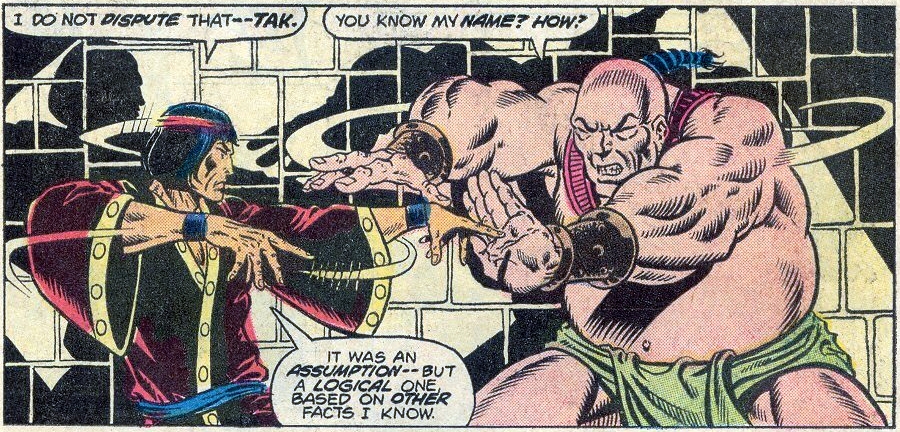
Starlin's artwork and page composition on this debut story are magnificent as, having been tricked into murdering the dying Dr John Petrie, Shang-Chi attacks his own father's HQ, battling assassins, the huge Sumo wrestler Tak and a giant insane gorilla along the way. It's a hauntingly grim tale, giving us a hero trained to further his father's empire of evil, one who makes his first foray into the outside world by killing a bed-ridden octogenarian, before a confrontation with his victim's friend Denis Nayland Smith - crippled by Fu Manchu - makes him realise it's his own father who's the threat to mankind, not his recent victim.
It has to be said, given all that Shang-Chi goes through to get to his father in this tale, the fact that when he finally reaches the heart of the fiend's lair, he just has a conversation with him, rather than bashing his head in, does feel like a let-down and makes no great sense. But, of course, the series would've been over before it'd begun if that'd happened and it does give Fu Manchu the chance to be stylishly evil in those closing moments, while setting things up nicely for the rest of the series.
Shang-Chi, Master of King Fu should never have been any good - being as it was, an obvious leap onto the martial arts bandwagon that was then sweeping the world, and its use of the hoariest of stereotypical villains. But its artistic success proves there's no such things as good ideas or bad ideas, just good and bad execution - and Master of Kung Fu, right from the start, had the finest of executions, even if the unfortunate Dr John Petrie might have argued otherwise.
![]() |
| Thanks to Fu Manchu, I know to end every conversation by receding into darkness. |
Subscribe to:
Comments (Atom)