Thanks to Charlie Horse 47 and Killdumpster for their sponsorship of this post, via the magic of Patreon.
Celluloid, what a gift it is to us.
And let us discover just what that gift was bestowing upon us in October 1986.
It was bestowing the following films because they were ones that were released in that very month: Children of a Lesser God, Tough Guys, The Color of Money, Jumpin' Jack Flash, Peggy Sue Got Married, Soul Man, Trick or Treat and The Mission.
And guess what?
That's right. I haven't seen a single one of them. I shall, therefore, take a wild punt at guessing that Tough Guys is the Steve Does Comics Movie of the Month.
Given that I don't have a clue what I'm talking about, that assessment may be completely incorrect.
And, if so, feel free to say so.
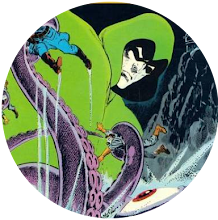
A dramatic cover tells us we're about to encounter a reprint of the Len Wein / Herb Trimpe epic that first introduced us to Wolverine!
And it all happens when a young woman tries to transfer the Wendigo's curse onto the
Hulk!
But that's not all because we also find, within, At the Sign of the Lion - starring Wolvie and Hercules - and the text article Wolverine: The Evolution of a Character. I think we can guess what that's likely to be about.
In my local comic shop?
On its literal shelves?
A brand new Marvel universe has been created?
And Star Brand #1 is part of it?
Strangely, given its title, it's not a sequel to Not Brand Echh and, with Jim Shooter behind it, I have no doubt it cannot fail!
While riding his motorbike in the mountains, Ken Connell's given the Star Brand, a powerful weapon that looks like a tattoo.
As you'd expect, it grants him strength, toughness and the power of flight.
But he's then attacked by an alien who wants it for himself!
And that New Universe gives us another new title when Spitfire and the Troubleshooters make their dynamic debut.
Karl Swensen, inventor of the Man Amplified X-periment Armour, is killed by an agent of his employer.
However, a woman who I assume to be his daughter is suspicious that his death may not have been an accident, returns to his lab, dons that armour to bring his killer to justice, and a whole new era in comics is born!
I'm sure we all remember Alien Legion. Now it gets a graphic novel in the form of a 67-page adventure from Alan Zelenetz, Carl Potts and Frank Cirocco. I have no idea what happens in it.
Scandalously not a part of the New Universe are the Hugga Bunch.
Thrillingly, that doesn't prevent them from getting a comic.
And what a comic it threatens to be when Stan Kay
and Warren Kremer bring us The Road to Riches and A King's Ransom.
This book is destined to last for six issues.
You can't keep a good man down. Even when he's made of plastic.
And only 12 inches tall.
And so it is that GI Joe gets another comic - and one in which Larry Hama and the almost inevitable Herb Trimpe do the duties.
A big moment has arrived because X-Factor - otherwise known as the Original X-Men - get their very first annual and fill it with forty pages of drama in which they visit Russia to give a talk about their mutant-hunting techniques.
And, while there, they manage to stop an evil mutant who's been experimenting on other mutants on behalf of the Russian state.
It's what we've all been praying for. Marvel's take on the Muppet-packed extravaganza in which a teenage girl wishes she could get rid of her baby brother, and David Bowie is only too glad to oblige.
Which is odd because I once wished I had a Porsche, and David Bowie did nothing about it.
Typical.
Iron Man grabs himself an eighth annual. One in which he discovers that something called Project Pegasus has a young boy in custody. One who can create anything he can imagine.
Needless to say, this can only lead to trouble.
Trouble so big that X-Factor too must get involved.
Meanwhile, the Incredible Hulk lands himself his 15th annual, with a cover by Mike Zeck and interiors by Sal Buscema.
However, all I know of this epic is that it's forty pages long and features both the Abomination and Tyrannus!
And yes, I've picked this one purely because it has a nice cover by Frank Cirocco.
Inside, it contains such yarns as A Camel's Curse, Monkey See, Monkey Die!, Facing the Tiger and Fossils, which are all new stories and distributed across the 52 pages that I have no doubt they fully deserve.


 Posts
Posts





%20000.jpg)


