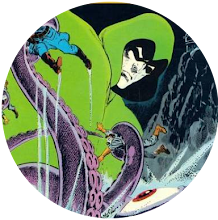
Well, this is all a rum do. I bought Essential Daredevil Volume 2 a few years ago - along with Volumes One and Three - and thought it was complete and total rubbish, filled with lame villains, a hopelessly tiny supporting cast -- and Mike Murdock.
But, of late, in the absence of anything better to fill my time with, I've been re-reading it.
This time, I did it differently. Instead of greedily devouring it in one long sitting - as is my habit when it comes to such collections - I decided to read it one story per day.
And what a magical difference it made. Suddenly, instead of a feeble hero fighting lame villains it was...
...well, OK, it still seemed like a feeble hero battling lame villains - but the drama of it all and Stan Lee's sense of fun shone through far more than it had before and I found I thoroughly enjoyed it.
Strangely, when read in bite-sized chunks, the uselessness of the villains becomes oddly charming, the tininess of the supporting cast seems cosy and even Mike Murdock becomes more-or-less bearable.
Of course, what does come across is that Matt Murdock is completely and totally mad. There's no other explanation for why he should adopt the eminently punchable persona of his non-existent identical twin brother Mike - especially when he at one point contemplates marrying Karen Page in that identity! As for his plan to bump Mike off with no regard for how Foggy and Karen might feel about his death...
Highlight of the collection has to be Dr Doom swapping bodies with DD in order to launch a surprise attack on the Fantastic Four.
It's a tale that makes no sense.
For a start, it follows straight on from a story in which the Trapster disguises himself as DD in order to launch a surprise attack on the Fantastic Four. Dr Doom somehow fails to notice he's now blind, DD finds himself in trouble fighting Doc Doom's goons, despite wearing a suit of armour that's weirdly unprotective against their bare fists, and Doom doesn't tell his lackeys his plan, meaning DD can order them around and plunge Latveria into a war that forces his adversary to completely abandon his scheme before he's even managed to reach the Baxter Building. Somehow, you can't help feeling Doom didn't put an awful lot of thought into this plan.
Despite all this, there is something about the sight of our hero alone and up against a villain he's totally outclassed by that means the tale lingers in the mind more than others do.
Another highlight is Daredevil's battle with a bunch of aliens who want to send everyone blind. It's a stupid tale - let's face it, if there's any menace DD shouldn't be fighting it's aliens - but it has a certain charm, and possibly highlights the difference between him and the superficially similar Spider-Man. Whereas Spider-Man fighting aliens seems wrong, for Daredevil it doesn't. Possibly this is because it's such an odd series - even when he's fighting more terrestrial foes - that it can get away with such eccentricities in a way that Spider-Man's strip couldn't.
Probably the weakest story is the character's first King-Size Special, where Lee redoes Amazing Spider-Man Annual #1 by having Daredevil's deadliest foes team up against him.
So undeadly are they that Electro has to be drafted in to give them some semblance of menace and, even then, Daredevil manages to beat the lot of them all in one go.
The book is, of course, dominated by Gene Colan's artwork. It could be argued his style wasn't best suited to super-heroes but there's a non-stop dynamism, flow and organised chaos to it that few artists can match.
So, there you have it, proof that comic book tales don't have to knock your socks off to be enjoyable.
And proof that the tales in compendiums are best read as they were originally meant to be read and not as impatience might dictate they be read.
Showing posts with label Marvel Essentials. Show all posts
Sunday, 17 March 2013
Wednesday, 31 August 2011
Essential Captain America Volume 1.
As I defy the warning notices and try to climb the trees in Sheffield's Winter Gardens, people often say to me, "Steve, why do you look so good naked and where did you get your ability to only ever be shot by stun guns?"
"It's simple," I tell them. "I got the first quality from drinking a strange frothing formula that turned me into a perfect physical specimen of humanity. I then had to kill the scientist responsible so there could never be any others like me. The second quality I got from reading too many issues of Captain America."
You guessed it. Thanks to my recent spending spree, I've been reading Essential Captain America Vol 1
.
Now, I must own up that I bought it because it was going cheap, rather than through any huge compulsion to catch up with the star-spangled superstar. In truth I read most of these tales as a kid, in the pages Marvel UK's The Titans but to say my memories were vague would be an understatement.
Still that didn't stop me leaping in with my usual gusto.
Surprisingly, Cap's Silver Age series doesn't kick off with his origin. Instead we leap straight into the action, with him seeing off a gang of crooks who break into the Avengers' Mansion. This lays down an early template with Cap repeatedly coming up against gangs of brawlers who he soon sees off with his fighting skills in what're clearly just an excuse for Jack Kirby to draw punch-ups.
After just a few stories however we're suddenly flung back into the past as, instead of present day tales, we're given a diet of World War Two outings. As with the very early Hulk comics, you get a feeling of Lee and Kirby not being quite sure what to do with the strip and trying different approaches to see what sticks. It's during this period that we get the classic retelling of Captain America's origin.
We also get the origin of the Red Skull, which comes after a jarring leap from the events of the previous issue, with no explanation of what happened in between. That aside, this is easily the best of the WW2 tales, even if the Skull's ascent from mere bellboy to arch-villain relies a little too much on luck on his behalf.
Clearly Lee and Kirby decide the WW2 approach isn't what the readership want because, after a few issues, they switch back to tales set in the present. Once there, the stories settle into one of two moulds. Either Captain America comes up against the always irritating Batroc the Leaper who quickly realises he's better off helping Cap than fighting him, or a mystery villain kidnaps SHIELD's enigmatic Agent 13, and Cap has to launch a one-man attack on his base to rescue her. The mystery villain nearly always turns out to be either the Red Skull or the almost identical Baron Zemo, and so the regular shock revelations rarely come as a shock.
For some reason, Lee and Kirby seem reluctant to move away from a James Bond template and also seem to fear straying too far from Cap's past, as we keep getting World War Two menaces repeatedly rising from the grave to pester him. This trend reaches its nadir when, in the present, he finds himself up against the 1st, 2nd and 3rd Sleepers, giant robots created by Hitler to destroy the world in the event of his defeat. To say the Sleepers are among the lamest robots ever seen in comics would be an understatement. Basically think of a giant robot hanging from a flying manta ray with a giant metal skull on top.
The one major exception to this World War Two-ness is the introduction of the huge-headed Modok who, despite being arguably the most interesting villain of the collection, only appears in one tale and isn't seen again, as we get yet more of the Red Skull and Zemo.
Modok aside, perhaps the strip's two most impressive creative contributions during this volume are the introductions of the Cosmic Cube - that little box that allows its owner to do anything he wants - and the 4th Sleeper, a Nazi robot far superior to its predecessors which, thanks to its control over its density, can walk around underground while firing devastating force beams upwards to destroy whole swathes of real estate.
One of the things you can't miss when reading this collection is that Captain America isn't a Silver Age character. He's a Golden Age one, crafted long before the Marvel template for the fallible hero was laid down, making him much less interesting than other Marvel do-gooders. There's also the problem that he'd been in suspended animation for nearly twenty years before returning in The Avengers and so, unlike other Marvel heroes, has no inbuilt supporting cast.
Lee and Kirby try to remedy this by making SHIELD and its agents his supporting cast but there's an obvious problem that, while this makes some sense - bearing in mind Nick Fury's shared World War Two background with Cap - it means it's Captain America's supporting cast and not Steve Rogers'. In these tales, Rogers literally has no existence. He has no family, no friends, no neighbours, no job, no interests, no hobbies. We simply never see him other than when he's about to become Captain America.
Even when Lee and Kirby try to give our hero a love interest in the shape of Agent 13, she's not Steve Rogers' love interest, she's Captain America's. Despite being in love with him, for most of this volume Agent 13 never even sees him without his mask. And when he finally does reveal his true identity to her, we get the unlikely sight of them on a date, with him referring to her throughout as, "Agent 13". Gwen and Peter this isn't.
There's also the somewhat bizarre idea that Cap's in love with her because she's identical to a resistance fighter he loved during the War. At one point it's hinted that Agent 13's the younger sister of that original love interest, making Cap's infatuation the sort of thing a psychiatrist would have a field day with. Fortunately, after their first meeting, that particular idea's never mentioned again. Nor is the fate of that original love interest, last seen in the 1940s, wandering off with amnesia.
This failure to develop Steve Rogers is a glaring weakness in the strip and means that while other Marvel titles of the era were able to widen and deepen their dramatic appeal though the heroes' private lives, the world of Captain America, even his love life, effectively becomes one long fight scene.
If the tales tend to be uninvolving on an emotional level, the upside of them is Jack Kirby's art which, mostly inked by Jolting Joe Sinnott, looks as good as it ever did, up until the final few stories when Syd Shores takes over the inking. I don't like to be mean but I've never liked Shores' inking and for me it does Kirby's work no favours here.
All in all, I can't get round the fact that there're good reasons I didn't previously remember these tales. Their reliance on action action action can make it a hard grind ploughing through them at times and you really do start to feel you're reading the same story over and over again. Still, it's yet another piece of Marvel's history caught up on and I did at least become reacquainted with the births of the Cosmic Cube, AIM and Modok.
The things I learned from reading Essential Captain America Volume 1:
1. Captain America survives most of his fights by dumb luck. In virtually every story, there's a point where the bad guys could kill him but choose not to because, "That would be too easy," or because, despite being ruthless killers/assassins, they're only packing stun guns.
2. All foreigners are stereotypes.
3. The Red Skull thinks Scotland is in England.
4. All vehicles belonging to top secret organisations whose existence the world knows nothing of, have the name of that organisation written on them in giant letters.
5. The Avengers have daily meetings with military types, at which they're given the current co-ordinates and travel plans for every US naval ship and submarine. Those meetings must just fly by.
"It's simple," I tell them. "I got the first quality from drinking a strange frothing formula that turned me into a perfect physical specimen of humanity. I then had to kill the scientist responsible so there could never be any others like me. The second quality I got from reading too many issues of Captain America."
You guessed it. Thanks to my recent spending spree, I've been reading Essential Captain America Vol 1
Now, I must own up that I bought it because it was going cheap, rather than through any huge compulsion to catch up with the star-spangled superstar. In truth I read most of these tales as a kid, in the pages Marvel UK's The Titans but to say my memories were vague would be an understatement.
Still that didn't stop me leaping in with my usual gusto.
Surprisingly, Cap's Silver Age series doesn't kick off with his origin. Instead we leap straight into the action, with him seeing off a gang of crooks who break into the Avengers' Mansion. This lays down an early template with Cap repeatedly coming up against gangs of brawlers who he soon sees off with his fighting skills in what're clearly just an excuse for Jack Kirby to draw punch-ups.
After just a few stories however we're suddenly flung back into the past as, instead of present day tales, we're given a diet of World War Two outings. As with the very early Hulk comics, you get a feeling of Lee and Kirby not being quite sure what to do with the strip and trying different approaches to see what sticks. It's during this period that we get the classic retelling of Captain America's origin.
We also get the origin of the Red Skull, which comes after a jarring leap from the events of the previous issue, with no explanation of what happened in between. That aside, this is easily the best of the WW2 tales, even if the Skull's ascent from mere bellboy to arch-villain relies a little too much on luck on his behalf.
Clearly Lee and Kirby decide the WW2 approach isn't what the readership want because, after a few issues, they switch back to tales set in the present. Once there, the stories settle into one of two moulds. Either Captain America comes up against the always irritating Batroc the Leaper who quickly realises he's better off helping Cap than fighting him, or a mystery villain kidnaps SHIELD's enigmatic Agent 13, and Cap has to launch a one-man attack on his base to rescue her. The mystery villain nearly always turns out to be either the Red Skull or the almost identical Baron Zemo, and so the regular shock revelations rarely come as a shock.
For some reason, Lee and Kirby seem reluctant to move away from a James Bond template and also seem to fear straying too far from Cap's past, as we keep getting World War Two menaces repeatedly rising from the grave to pester him. This trend reaches its nadir when, in the present, he finds himself up against the 1st, 2nd and 3rd Sleepers, giant robots created by Hitler to destroy the world in the event of his defeat. To say the Sleepers are among the lamest robots ever seen in comics would be an understatement. Basically think of a giant robot hanging from a flying manta ray with a giant metal skull on top.
The one major exception to this World War Two-ness is the introduction of the huge-headed Modok who, despite being arguably the most interesting villain of the collection, only appears in one tale and isn't seen again, as we get yet more of the Red Skull and Zemo.
Modok aside, perhaps the strip's two most impressive creative contributions during this volume are the introductions of the Cosmic Cube - that little box that allows its owner to do anything he wants - and the 4th Sleeper, a Nazi robot far superior to its predecessors which, thanks to its control over its density, can walk around underground while firing devastating force beams upwards to destroy whole swathes of real estate.
One of the things you can't miss when reading this collection is that Captain America isn't a Silver Age character. He's a Golden Age one, crafted long before the Marvel template for the fallible hero was laid down, making him much less interesting than other Marvel do-gooders. There's also the problem that he'd been in suspended animation for nearly twenty years before returning in The Avengers and so, unlike other Marvel heroes, has no inbuilt supporting cast.
Lee and Kirby try to remedy this by making SHIELD and its agents his supporting cast but there's an obvious problem that, while this makes some sense - bearing in mind Nick Fury's shared World War Two background with Cap - it means it's Captain America's supporting cast and not Steve Rogers'. In these tales, Rogers literally has no existence. He has no family, no friends, no neighbours, no job, no interests, no hobbies. We simply never see him other than when he's about to become Captain America.
Even when Lee and Kirby try to give our hero a love interest in the shape of Agent 13, she's not Steve Rogers' love interest, she's Captain America's. Despite being in love with him, for most of this volume Agent 13 never even sees him without his mask. And when he finally does reveal his true identity to her, we get the unlikely sight of them on a date, with him referring to her throughout as, "Agent 13". Gwen and Peter this isn't.
There's also the somewhat bizarre idea that Cap's in love with her because she's identical to a resistance fighter he loved during the War. At one point it's hinted that Agent 13's the younger sister of that original love interest, making Cap's infatuation the sort of thing a psychiatrist would have a field day with. Fortunately, after their first meeting, that particular idea's never mentioned again. Nor is the fate of that original love interest, last seen in the 1940s, wandering off with amnesia.
This failure to develop Steve Rogers is a glaring weakness in the strip and means that while other Marvel titles of the era were able to widen and deepen their dramatic appeal though the heroes' private lives, the world of Captain America, even his love life, effectively becomes one long fight scene.
If the tales tend to be uninvolving on an emotional level, the upside of them is Jack Kirby's art which, mostly inked by Jolting Joe Sinnott, looks as good as it ever did, up until the final few stories when Syd Shores takes over the inking. I don't like to be mean but I've never liked Shores' inking and for me it does Kirby's work no favours here.
All in all, I can't get round the fact that there're good reasons I didn't previously remember these tales. Their reliance on action action action can make it a hard grind ploughing through them at times and you really do start to feel you're reading the same story over and over again. Still, it's yet another piece of Marvel's history caught up on and I did at least become reacquainted with the births of the Cosmic Cube, AIM and Modok.
The things I learned from reading Essential Captain America Volume 1:
1. Captain America survives most of his fights by dumb luck. In virtually every story, there's a point where the bad guys could kill him but choose not to because, "That would be too easy," or because, despite being ruthless killers/assassins, they're only packing stun guns.
2. All foreigners are stereotypes.
3. The Red Skull thinks Scotland is in England.
4. All vehicles belonging to top secret organisations whose existence the world knows nothing of, have the name of that organisation written on them in giant letters.
5. The Avengers have daily meetings with military types, at which they're given the current co-ordinates and travel plans for every US naval ship and submarine. Those meetings must just fly by.
Labels:
Captain America,
Marvel Essentials
Sunday, 21 August 2011
Essential Thor Volume 4.
As I mentioned the other day, I've recently bought a pile of Marvel Essentials and, being the Thor fan that I am, I was never in any doubt which was going to be the first one I read.Like a good football match, The Essential Thor Volume 4's a game of two halves. The first dominated by the latter days of Jack Kirby, the second by John Buscema, with a well-known guest artist to keep us entertained at half-time.
It all kicks off with Thor sent on a quest to discover the origin of Galactus. Whilst it's good to see Galactus again, his origin turns out to be something of a let down, as we discover he's just some bloke who got exposed to radiation, grew big and started eating everything. By this point we'd seen so many Marvel characters who'd got their start by being exposed to radiation that it all feels way too humdrum an explanation for Marvel's biggest of Big Bads.
Once this tale's done, the remainder of Jack Kirby era spends most its time reworking older stories as we get a rematch with the Wrecker, the Circus of Crime and Ulik. Even the new villain Crypto-Man features in a story that's a fairly blatant rehash of the Replicus tale from issue #141. While these tales are all fun, it's hard to avoid the feeling that, as with The Fantastic Four, by the time he'd left, Kirby's best work on the strip was already waving to him in the rear-view mirror.
As though to prove it, the major storyline of this late Kirby period's a straight reworking of the first Mangog outing when, thanks to getting his hands on the Odin-Ring as Odin sleeps, Loki seizes the throne of Asgard - only for Surtur to inconveniently appear and attack the kingdom. As in the Mangog tale, all seems lost until Odin awakes from his slumbers to dispatch the threat with no noticeable difficulty.
After this is we get an odd little tale - presumably a last minute fill-in - in which John Buscema takes over for an issue to give us Thor versus the Abomination. It's a tale that reveals that Thor can turn back time, which he's never done before and which you would've thought makes him effectively unbeatable.
Jack Kirby returns for just one issue before departing for good, followed by Neal Adams' debut on the strip as Thor and Loki swap bodies in a tale involving Mephisto. I'm not convinced it's a happy debut. It all looks as slick as you'd expect but Joe Sinnott's inks are so distinctive that, however polished it is, it looks more like Rich Buckler's Neal Adams impersonation than it does the real thing. For me it also lacks the dynamism of both Kirby and his long-term successor.
That successor is John Buscema who returns with a Dr Doom scrap before it's back into epic territory with the tale of Infinity, a star-devouring hand that turns out to be Odin's dodgy side unleashed by Hela.
Happily Infinity's seen off.
Not so happily, Hela's in a bad mood about the foiling of her plans, and kills Thor, only for wimpy old Sif to touch the Death Goddess with her tears, causing Hela to bring him back.
Unfortunately when they all return to Asgard, Loki's got his hands on the Odin-Ring (again) and has seized the throne (again). Instead of giving Loki a good smacking like he should, Odin stays as annoying as ever and goes off to have a kip, leaving Loki to do whatever he wants.
What he wants is to get his leg-over with Sif and create a creature called Durok the Demolisher who spends a fair amount of time knocking Thor around before knocking the Silver Surfer around. Highlight of all this has to be Durok smashing the Surfer's board to pieces. I always liked to see the Surfer suffer.
But there's still no rest for the dunderheaded because, having finally woken up, Odin banishes Loki to the place where Mangog's buried. Needless to say it's not long before the block headed villain releases the monster, and Odin has to thus send our cast off on yet more quests. At this point we meet the Asgardian warrior woman Hildegarde. Hildegarde as a character's great but has one obvious flaw which is that, with her rugged fighting ways, she really does rub-in what a complete and total wet dish-cloth Sif is in comparison.
You can't get away from it that there's an awful lot of repetition going on in these tales, with two reruns of the original Mangog tale and two epics involving Loki taking over Asgard by getting his hands on the Odin-Ring. Just how stupid is Odin that he learns nothing from the earlier problems and still leaves the Odin-Ring lying around for Loki to find? It's also annoying that Odin keeps going into the Odin-Sleep every time he's needed. You really do wonder why the people of Asgard revere the useless old berk.
But there're new ideas too - the main ones being to do with the characters. Freed from the constraints of working with the more concept-oriented Kirby, Stan Lee clearly starts to remodel the strip the way he wants it to be, as grandiose soap opera. This is no bad thing. As the strip goes along it's obvious it's becoming more and more an ensemble piece and less and less a solo strip, as Balder, Volstagg, Fandral and Hogun get more and more page time.
They're not the only ones. Once Gerry Conway takes over the writing chores, there's also the introduction of the strapping Hildegarde, brought in to accompany the increasingly useless Sif on a mission, while, before Lee goes, Hela, rarely seen in the strip before this era, gets noticeably more involvement.
But perhaps the most interesting thing about these tales involves Karnilla the Norn Queen, as we see her gradually evolving from out-and-out villain to a more ambiguous figure, purely through her love for Balder. Balder meanwhile finds himself torn from emotional pillar to post as he tries to balance his love for Karnilla with his sense of duty to Thor, Odin and Asgard. To a large degree, although the comic's called Thor, these are really the adventures of Balder and Karnilla, and the strip's all the better for it.
Labels:
Books,
Marvel Essentials,
Thor
Tuesday, 16 August 2011
Marvel Essentials.
Sometime in the late 1990s, I walked into the now-deceased Star Store on Sheffield's Cambridge Street and stumbled across a humble little book on a low shelf. It clearly hadn't been cut right - the cover being marginally smaller than the pages it was meant to be covering.
However, a close inspection revealed it reprinted the first 20-or-so issues of The Amazing Spider-Man - in glorious black and white, just as I remembered them as a child.
Needless to say I had to buy it.
That slightly dog-eared book was of course The Essential Spider-Man and, since then, those mind-controlling villains at Marvel have taken full advantage of my mental weakness by bringing out ever-more Marvel Essentials to prise my money from me. Creaking are my shelves with the weight of Essentials.
Well, there's no fool like an old fool and, still bitten by that bug, I've just gone mad and bought a whole slew more of the things: Thor Volumes 4 and 5, The Avengers Volume 6, and even the first two Captain America Essentials, even though I have no great interest in Captain America.
In terms of consistency my favourite run of Essentials is The Amazing Spider-Man from the start of Steve Ditko all the way through to the end of Ross Andru. The ability of that strip through the first fifteen years of its life to keep improving as it went along's genuinely astonishing and reflects just how strong the central concepts and characters of the title really were.
My favourite individual volume's probably Essential Avengers Volume 3 with all those Roy Thomas/John Buscema/George Klein tales.
My least favourite so far's been the Essential Killraven which totally failed to engage me despite me having loved the strip as a child. And I can't ignore the fact that Volume 1 of The Incredible Hulk's mostly poor, with even the likes of John Buscema and Gil Kane somehow failing to bring it to life.
Even for one with my addiction to the books, I can't deny there are certain Essentials I'll probably never own. With all the will in the world, I can't see myself ever buying The Essential Human Torch or Essential Ant-Man. However, Essential Sub-Mariner and Captain Marvel are on my future shopping list, as are all the Tomb of Dracula and Defenders books.
All this rambling is of course not done without ulterior motive. It's simply my way of leading up to the big question. Are you a fan of the Marvel Essentials and which have been your favourite and least favourite ones so far?
However, a close inspection revealed it reprinted the first 20-or-so issues of The Amazing Spider-Man - in glorious black and white, just as I remembered them as a child.
Needless to say I had to buy it.
That slightly dog-eared book was of course The Essential Spider-Man and, since then, those mind-controlling villains at Marvel have taken full advantage of my mental weakness by bringing out ever-more Marvel Essentials to prise my money from me. Creaking are my shelves with the weight of Essentials.
Well, there's no fool like an old fool and, still bitten by that bug, I've just gone mad and bought a whole slew more of the things: Thor Volumes 4 and 5, The Avengers Volume 6, and even the first two Captain America Essentials, even though I have no great interest in Captain America.
My favourite individual volume's probably Essential Avengers Volume 3 with all those Roy Thomas/John Buscema/George Klein tales.
My least favourite so far's been the Essential Killraven which totally failed to engage me despite me having loved the strip as a child. And I can't ignore the fact that Volume 1 of The Incredible Hulk's mostly poor, with even the likes of John Buscema and Gil Kane somehow failing to bring it to life.
Even for one with my addiction to the books, I can't deny there are certain Essentials I'll probably never own. With all the will in the world, I can't see myself ever buying The Essential Human Torch or Essential Ant-Man. However, Essential Sub-Mariner and Captain Marvel are on my future shopping list, as are all the Tomb of Dracula and Defenders books.
All this rambling is of course not done without ulterior motive. It's simply my way of leading up to the big question. Are you a fan of the Marvel Essentials and which have been your favourite and least favourite ones so far?
Labels:
Books,
Marvel Essentials
Subscribe to:
Posts (Atom)