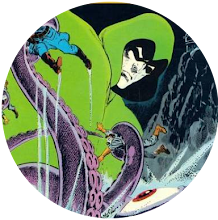
Thanks to Charlie Horse 47 and Killdumpster for their sponsorship of this post, via the magic of Patreon.
***

If there was one thing you couldn't move for in the 1970s, it was DC horror anthologies, with the spinner racks awash with the likes of House of Secrets, House of Mystery, The Witching Hour, The Unexpected and a zillion other titles.
However, one was different.
Unlike those other books, Black Magic was a reprint title and was, thus, more in the vein of the horror anthologies Marvel was producing at the time, such as Tower of Shadows and Tomb of Darkness.
Sadly, this policy didn't prove any more successful for DC than it was for Marvel and, despite its enticing title, the book only survived for nine issues before meeting its maker.
While I remember there being plenty of DC house ads for issue #1, issue #6 is the only one I ever actually owned.
So, let's see what this nightmarish delve into terror contains.

Seeking a high window to leap out of, he makes his way to a room on the 13th floor of a building, only to discover, when he enters, that it's the waiting room for the Afterlife and that he's now in danger of being dragged off to hell by Satan himself.
Happily, he finds his way back to the outside world and, lesson having been learned, decides not to commit suicide, after all.
That synopsis makes it all sound quite nightmarish but, despite being played totally straight, it's surprisingly light in spirit, bringing to mind such movies as A Matter of Life and Death.

Mark's problem is Lisa says she can't marry him as long as the shadow of Peggy hangs over her. Thus, he sets out to talk sense to the magnificently psychotic Peggy who responds by deciding she's going to kill him.
It'll come as a surprise to absolutely no one that the tale climaxes with Mark discovering Lisa doesn't actually have a sister.
And we end with a cliffhanger, as the door of the room he's in starts to open and Mark doesn't know if the woman walking in through it is going to be Lisa or Peggy.
Now, we're offered The Girl Who Walked on Water! brought to us by Joe Simon and Jack Kirby.

But their plans are scuppered when her friend Tommy tries to copy her feats, and falls from a window. So badly injured is he that it destroys her belief that it's possible to do such things. And, thanks to this, her ability abandons her.
But we end with I Wouldn't Let Him Die, a one-page text story which I haven't read because it doesn't have pictures, and I have a pathological fear of comic book stories that don't have pictures. I'm sure it's great, though.
So, how does this collection of Golden Age goodness stand up?
Surprisingly well. I've commented before that Golden Age horror tales are not exactly terrifying. Then again, neither are Bronze Age ones. And these are definitely not terrifying.
But the first two tales really do have a strong movie feel about them, as though you're seeing cinema acted out before you in the form of comic book panels. The third feels more like a comic book tale but has a surprising potency, thanks to Anna Marie's distress over the harm poor Tommy comes to because of her. We never learn how serious that harm is but we are told he's, "Hurt awful bad."
So, yes. to my surprise, I give it a thumbs up.
And that means I'm going to view it as an affront to the powers of darkness themselves that it only lasted for a handful of issues.
Assuming, of course, that the powers of darkness care.


 Posts
Posts