Showing posts with label Books. Show all posts

Saturday, 23 March 2019

Dan Cooney, The Graphic Novelist's Guide to Drawing Perspective - Review.

Dan Cooney, The Graphic Novelist's Guide to Drawing Perspective
For many years, mankind has been puzzled by the strange quirk of fate that means the people who live a long way away from us are smaller than the people who live closer to us. An even greater mystery has always been where do those tiny people disappear to when you try to go there and conquer them?

But now, at last, Steve Does Comics can exclusively reveal they're not tiny at all. They're normal-sized and it's all an illusion caused by a thing called perspective.

But it seems I'm not alone in having realised this, and entire books have been written on the subject.

One such book is the one I was sent the other day by the good people at Search Press. Written by Dan Cooney, The Graphic Novelist's Guide to Drawing Perspective sets out to explain and demonstrate all the budding artist could ever want to know about the phenomenon and how it can be incorporated into our masterpieces.

It's a very exhaustive book indeed which, as you'd expect, deals with the horrors of one-point, two-point and three-point perspective but also touches on a whole range of other things necessary to the artist, such as the materials needed for drawing, the importance of carrying a sketch pad with you, as you seek out examples of perspective in the real world, advice on how to place your vanishing point, the Rule of Thirds, tips on drawing the human figure, how to use perspective to make your work feel more dynamic, and a whole heap of other stuff of value to the artist. In doing so, it uses a plethora of images, not only by Cooney himself but by a number of other industry professionals. Needless to say, I was especially impressed by Judge Dredd showing up.

The book's extremely thorough and technical in how it goes about its business and perhaps its most useful feature is that it's packed with designated worksheets on which you can carry out the exercises laid out in the book, meaning it functions as a course in perspective rather than just being a reference or instruction book.

So, if you've ever wanted to gain a fuller understanding of just how to incorporate perspective into your visual work, this is the book for you.

Tuesday, 19 June 2018

The Power Pack of Ken Reid.

Ken Reid collected book form edition Irmantas Povilaika volume 1
Anyone who ever read a British comic in the period from the 1940s to the late 1980s will be familiar with the work of Ken Reid who produced sterling work for the likes of The Beano, Dandy, Cor, Buster, Smash, Pow, Whoopee and Monster Fun. Among his claims to fame was that he co-created Roger the Dodger and Faceache.

But now there's a chance for any Ken lovers to express that love in book form because Irmantas Povilaika is aiming to release a complete official collection of Reid's strips from Wham, Smash and Pow, including the complete Frankie Stein, Jasper the Grasper, Queen of the Seas, Dare-A-Day Davy and The Nervs.

As well as all that, the venture will include unseen sketches, drawings, and facsimiles of hand-written scripts, with introductions by Ken's son Antony J Reid, Beano artist Nigel Parkinson and British comics historian Steve Holland. There'll also be a detailed illustrated biography, covering the years when Reid worked for Odhams Press.

Ken Reid collected book form edition Irmantas Povilaika volume 2
The collection consists of two hard-cover volumes, of 204 pages each and, to raise the money for this venture, Irmantas is now running a crowdfunding campaign on Indiegogo. The campaign has just three more weeks to run, so if you want to help the project become a reality, you can find out more at: https://www.indiegogo.com/projects/the-power-pack-of-ken-reid-books/x/18513990#/  and by visiting Irmantas's own blog Kazoop!!

Wednesday, 15 October 2014

The Doctor Who Monster Book.

Doctor Who Monster Book, Chris Achilleos
Forget Spider-Man. If you have any sense at all, there's only one thing in this world that you want to see stuck to the side of a building.

And that's a police box.

Reader, in 1977, I saw that police box. It was stuck to the side of a building in Blackpool, Lancashire, England, Britain, Europe, the Earth.

Inside that police box was not a policeman. It was an exhibition.

It was a Doctor Who Exhibition. An exhibition that could only be accessed by entering that box and then descending a flight of stairs, into a basement.

Within that basement were many things.

There was a Dalek threatening you as you arrived.

There was a Sea Devil pointing its deadly round thing at you.

There were yet more Daleks, roaming around on rails, doing yet more threatening.

On the walls were stills from the making of the show, including the story The Talons of Weng-Chiang. How all visitors must have gasped at the site of ex-jungle-brawler Leela being nibbled on by a giant rat.

Most important of all to this story, there was a shop. And that shop sold only things related to the universe's greatest Time Lord.

From that shop, I got The Doctor Who Monster Book, a staple-bound book filled with articles about the Doctor's greatest enemies. In its centre was a poster by Chris Achilleos, the man who did all those covers for the show's epic Target novelisations.

In the modern age, none of this might seem that exciting but, in the dark days of the 1970s, when the internet didn't yet exist and old episodes couldn't be found on videotape, a book filled with photos of the show's greatest menaces was a Godsend. At last I could be reacquainted with the monsters I recalled from years gone by and I could meet other monsters I had no memory of at all.

There was a Giant Robot. There was a Zygon. There were hordes of Daleks on Westminster Bridge and a Mechanoid doing whatever it was Mechanoids did. Most intriguingly of all, there were the Zarbi, man-sized ants with human legs. What terrible powers of evolution had combined to create such a creature? Truly, this was the greatest book ever published.

I accept that this site is called Steve Does Comics and that that book was not a comic. But I don't care. Some things are so awesome they have to be shared with the world. Even things that aren't comics.

And if you fear it's too much to ask of flesh and blood to endure a post about a book on a comics site, just thank Rassilon I didn't do a post about the picture cards I used to get from boxes of tea. Now there is a post I'm saving up for when I have nothing at all else left to write about.

Saturday, 26 October 2013

The Trigan Empire.

The Trigan Empire, Book
As I roam the majestic heights of Wincobank Iron Age hill fort, people often say to me, "Steve, it fills you with awe, doesn't it, to think that two thousand years ago, the people of Sheffield were stood on this very spot, murdering Italians."

"I don't blame them," I say. "I could murder a spag bol myself right now."

"Not Italian meals, you half-witted buffoon!" they declare. "Italian people. This was the front line in the battle between the ancient Brigantes tribe and the invading Romans."

"Well, Meadowhall shopping centre's nearby," I point out. "So at least they wouldn't have run out of supplies."

At which point, they turn their back on me and walk off as though I'm some sort of imbecile.

"But it has twelve thousand parking spaces!" I call after them, "And a Poundland! No wonder the Romans wanted it!"

The Trigan Empire, Don Lawrence
But of course I'm merely teasing them; as I'm fully aware of the history of the Roman Empire, thanks to The Trigan Empire, the comic strip which gave us Romans as they should have been - ie, with spaceships and ray guns.

I first encountered the strip in the pages of the short-lived Vulcan comic and was immediately struck by the superiority of its artwork.

Trigan Empire, execution
The three issues of that mag that I owned were all I heard of the strip until a few years later when I was given a hardback book for Christmas. That book pulled the early tales together into a volume so heavy that, had the Brigantes used it as a weapon, the Romans would have been forced to flee and history would have been so very very different.

Trigan Empire, flood
Created in 1965, by Don Lawrence and Mike Butterworth, it told the tale of an alien civilisation that bore a remarkable resemblance to Ancient Rome, and followed it as, thanks to the efforts of one man, it rose from barbarism to become the dominant force upon its home world.

To be honest, the story itself never did that much for me, with its somewhat one dimensional characters, over-reliance on replicating old Earth civilisations and some fairly dodgy racial stereotyping but it was one of the most beautifully illustrated comic strips I'd ever seen - and that alone was enough to justify its existence for me.

Sadly, I no longer have that book. I sold it on eBay many moons ago but like to think that, somewhere, someone is using it as the blueprint for their own attempts to conquer the world.

Thursday, 11 July 2013

The Horrific World of Monsters.

Dulan Barber, The Horrific World of Monsters
As I scale the glassy heights of Sheffield's Velocity Tower, in protest at inappropriate drilling for oil, people often lean out of the windows and say to me, "Steve, with what do you associate Christmas 1974?"

And I tell them, "With what? I'll tell you with what I associate it. I associate it with toffee. I associate it with Quatermass and the Pit - which may or may not have been on TV that Christmas. And I associate it with The Horrific World of Monsters."

Yes, it's true. For Christmas 1974, I was given that self-same book.

And what a magnificent tome it was, giving information about virtually every monster you could ever hope to encounter.

It had such Hammer and Universal standbys as Frankenstein's Monster, Dracula and the Wolfman.

It had dinosaurs.

It had Kong.

It had monsters from ancient mythology.

It had Japanese monsters.

It had British monsters.

It had real-life monsters like the Yeti and Nessie.

It even had Marvel super-heroes.

Granted, even at the time, it seemed a little strange to see the likes of Spider-Man and the Fantastic Four labelled as monsters but I didn't care. The inclusion of such characters meant we got reproductions of pages of artwork and pin-ups from said comics. How we thrilled as the Human Torch encountered Annihilus, and the Hulk met the Bi-Beast.

Monsters' Who's Who by Dulan Barber
It was from that book that I learned of the existence of Angar the Screamer.

It was from that book that I learned of the dread Anthropophagi, those mystery cannibals whose mouths are in their chests

For a Dr Who fan like me, it was a treat, as it featured old stills of such Dr Who monsters as the Daleks, Cybermen and Ice Warriors at a time when we had access to neither repeats of the show nor recordings.

All in all, I do believe it may qualify as the greatest book ever written.

A bit of Googling tells me it was written by someone called Dulan Barber, of whom I know nothing. But I do recall the book was often advertised in American comics at the time, where it was re-titled The Monsters' Who's Who. But, whatever name it went by, it was thoroughly and totally monsterific.

Monday, 16 April 2012

Stone. Don't risk being the last on your block to get it.

Stone by Stephen Walker available from Amazon Kindle
It's time once more for all readers of Steve Does Comics to despair as I plug my latest eBook that's now available on Amazon.

Stone tells the tale of what happens when the 12th Daughter of Destiny goes in search of her lucky hand and finds instead the effects of a curse that ties the world of Ancient Mythology to the present. I won't give away too much but if I use the phrase, "A head full of snakes," I think you might have a clue where I'm coming from.

Such is its sensational selling power that, after mere hours online, Stone has already hit the dizzy heights of #90 in Amazon UK's Fantasy Short Story category and is currently available for just 99 Cents, 77 Pence or 0.89 Euros, depending on your geographical location.

Remember, you don't need one of those fancy Kindle machine things to download it. All you need is one of those fancy computer machine things that I suspect you already have, or you wouldn't be reading this.

Download Stone from Amazon.Com, Amazon UK, Amazon Germany, Amazon France, Amazon Spain, or Amazon Italy, right now - because your brain deserves it.

Saturday, 18 February 2012

Bring on the Bad Guys.

Bring on the Bad Guys, John Romita cover, Mephisto,GreenGoblin,Dormammu,Abomination,Red Skull,Loki,Stan Lee
Anyone who's ever seen me striding through the aisles of my local Poundland, pushing people aside and declaring, "Out of my way, clod!" knows I've always had a certain leaning towards the villainous.

And so it is that, while Son of Origins might have had my favourite cover of the Marvel Origins books, Bring on the Bad Guys had my favourite contents.

I received it the same Christmas as its two predecessors and still recall the thrill of reading it for the first time.

Fittingly for a man who's arguably Marvel's greatest ever villain, we got two Dr Doom tales; his first ever appearance in the Fantastic Four and then his actual origin.

There was the genesis of the Red Skull in a tale that seemed to go on forever, the origin of the Green Goblin and the creation of the Abomination.

We got the first ever appearance of Dormammu, which was a marvellous thing from Steve Ditko, as Dr Strange entered a weird and disorienting landscape. He met Clea, he met the Mindless Ones, he got a new cape. Most of all he met a villain who was not only more powerful than him but also turned out to have his own brand of morality.

The Loki section was an odd thing, giving us two tales from his childhood and then a Thor story that mostly focused on the first appearance of the Absorbing Man. Given that it was the second half of a two-parter and Loki wasn't even its main villain, it always seemed a strange choice and you'd have thought there were more suitable stories out there they could've used. Still, the sight of Crusher Creel absorbing the power of the Earth itself as he grew to gigantic size was always an appealing one.

It could be argued that having the book feature the Abomination, instead of the Hulk's true arch-foe the Leader was also an odd one but I've always felt the Abomination's first appearance was a far better story than the Leader's, so the choice made sense and did give us a reminder of Gil Kane's stint on the strip.

But the highlight of the book for me was the first appearance of Mephisto. John Buscema's art was a thing of beauty as the Silver Surfer battled the living embodiment of evil itself. I still swear to this day that Mephisto in this tale bore a remarkable facial resemblance to my dad and, despite the tale seeming to be a million pages long, it never outstayed its welcome.

Tuesday, 14 February 2012

Son of Origins of Marvel Comics.

Son of Origins of marvel Comics, cover, John Romita, Iron Man, Daredevil, Silver Surfer, Nick Fury, Watcher, Scarlet Witch
Hooray! It's Valentine's Day! And that can only mean one thing.

Son of Origins of Marvel Comics.

Son of Origins of Marvel Comics always had my favourite cover of the first three Marvel Origins books, even though, looking at it now, I'm not sure why the Scarlet Witch is on it, seeing as how to my recollection there's no sign of her inside the thing.

Of course, her old gang the Avengers did appear, having their first ever adventure as they tried to deal with both the Hulk and then Loki.

But, as if such excitement wasn't enough for us, we also got the origins of the X-Men, Iron Man, Daredevil, Agent of SHIELD, the Watcher and the Silver Surfer. Still no origin of Ant-Man and, more oddly, still no origin of Captain America.

Still, what we did get was more than enough to make up for such absences.

Even though I never liked the original X-Men, I did always enjoy their debut outing. It featured a charming naivety to it and an appealing minimalism to their costumes. Iron Man's origin's always been one of my favourites. And, though I've never been a fan of Nick Fury, the origin of SHIELD was OK and did at least feature a flying car. The Watcher's origin gave us a stark morality tale I've always born in mind before interfering in the affairs of other worlds.

But the highlight for me at the time was the origin of the Silver Surfer, mostly because I'd not read it before. Plus,at a million pages long, and featuring Galactus, it had a certain epic quality.

Unlike the first Origins book, we didn't get a later tale from the career of each of our heroes but did get later stories for Iron Man and Daredevil. The Daredevil story was a perfect selection but the Iron Man tale, featuring the Maggia and Whiplash was Part One of a multi-part story and therefore ended just as it got exciting.

Overall, I recall it as a less focused book than the first - and featuring the Watcher rather than Captain America does, in hindsight, seem plain perverse - but, as I sat there on the Christmas Day of what I believe to be 1976, reading my brand new present, none of that mattered.  All that mattered was my heroes were once more saving the day and I had a brand new cover to try and draw a copy of.

Monday, 6 February 2012

Origins of Marvel Comics.

Origins of Marvel Comics, Stan Lee, John Romita cover, Fantastic Four, Sub-Mariner, Spider-Man, Dr Strange, Hulk, typewriter, hands
First off, I promised the man the world knows as Capn Midnight that I'd give a plug for his comic Zombie Outlaw. So, if you don't have enough zombies in your life - or would rather spend your time with the outlaws than the in-laws - it might be just the thing for you.

But it's now time for Steve Does Comics to leave such gruesome matters behind and perform its speciality of reviewing something I've not actually read.

Well, OK, that's not strictly true. I've read Origins of Marvel Comics more times than I could shake a Skrull at but I  haven't had my hands on a copy for a good fifteen years, meaning I'm going to have to ramble on about my vague recollections of it and hope they bear some resemblance to reality.

I was given the first three Marvel Origins books on Christmas Day in what may have been 1975 and, of course, quickly realised they're the three greatest books ever published in the history of mankind, containing as they do the births of our favourite heroes and villains.

First of the Triptych of Tremendous was Origins of Marvel Comics. How could I not love it? Not only did it have Stan Lee's hands on the cover but it gave us the first appearances of the Fantastic Four, Spider-Man, the Hulk, Thor and Dr Strange. Sadly, Ant-Man, who was technically Marvel's second ever super-hero, was nowhere to be seen.

Still, as if the origins we did get weren't enough to make any Christmas, we also got a bonus story for each of those characters, from a few years later in their development.

Admittedly the choice of later stories could in places seem a little odd.

The later Fantastic Four tale barely featured the Fantastic Four at all, concentrating as it did on the Thing fighting the Silver Surfer.

It was hard to argue against the story featuring the Hulk vs Sub-Mariner. With its lack of the usual supporting cast, it could hardly be called a typical example of that phase in the strip's history but it had two of Marvel's mightiest heroes going toe-to-toe, so who was ever going to complain about that?

The later Spider-Man tale featured the Shocker. It was entertaining enough - and gave us a fair bit of Peter Parker's personal woes but, given the string of classics to choose from, and the fact it was atypical in being drawn by John Buscema, I always felt there must've been more logical tales to choose from.

The selection for the later Thor story always seemed plain perverse to me - being Part One of a two-part story, meaning it ended just as it was getting exciting. Not only that but it was inked by Bill Everett instead of Vince Colletta, meaning we didn't get a flavour of the strip's usual look.

I must admit I can recall barely anything about the later Dr Strange tale other than it was drawn by Marie Severin and featured Umar. To be honest, such was its lack of impact on me, I think I may have only read it once and never bothered to revisit the tale. The failure to select a Gene Colan/Tom Palmer outing really did strike me as baffling.

The other Dr Strange tales - featuring his Steve Ditko drawn debut and his origin - were of course beyond reproach.

I think Thor's origin was the only one I'd actually read prior to getting the book, so it was an eye opener to see exactly how my much-loved heroes started out. The Fantastic Four tale, with its origin and then meeting with the Mole Man felt incredibly long and epic. Spider-Man was of course an emotion-packed classic.

But my favourite origin of the ones presented here had to be the aforementioned Thor. There's still something about Don Blake finding that cane in that cave, and the Stone Men From Saturn's invasion attempt that always grabs me.

My least favourite of those origins was probably the Hulk's. The bit where he actually became the Hulk was fine but the later section with the Gargoyle all felt somewhat workmanlike and of its time compared to the other origins.

At the time I had the book I wasn't aware of the controversies over who created what in the Marvel Universe and so took as gospel Stan's recollections of himself basically coming up with everything. It'd be interesting to read Stan's text sections today, with that in mind.

I also now know the golf match at which Martin Goodman decided he needed an answer to the Justice League may never have happened, that Amazing Fantasy #15 may not have been planned to be the last ever issue when Spider-Man was slotted into it, and that a whole bunch more anecdotes about how things unfolded may have owed more to Stan Lee's faulty memory and breezy willingness to bend reality to the needs of a good story than they did to accuracy.

So, as a historical document it was probably somewhat unreliable but it helped make my Christmas one year, and anything that makes a child's Christmas can't be totally without merit.

Wednesday, 9 November 2011

Les Daniels, RIP.

Les Daniels, Five Fabulous Decades of the Worlds Greatest Comics. Spider-Man climbs a wall. John Romita Cover
As has already been reported on various other sites, including Bronze Age Babies and Rip Jagger's Dojo, writer and comics historian Les Daniels has passed away.

I must confess I only really knew Les Daniels from his book Marvel: Five Fabulous Decades of the World's Greatest Comics which I bought almost exactly 20 years ago. It's a scary thought that if he wrote it now it'd have to be called Seven Fabulous Decades of the World's Greatest Comics.

But that just reveals how much time's passed since then. These days, thanks to the Internet, one can find out pretty much anything one wants to about comics, with the press of a button. But, back then, when such limitless resources were barely more than a twinkle in the eyes of some mad scientist, reading such a book was like finding a horde of buried treasure, packed with pictures, anecdotes, info and quotes from famous creators.

It really was a joy to behold, and still is. And for that, although I knew next to nothing about him, I shall always be grateful to Les Daniels. You can read what I had to say about that book by clicking on the picture above.

Sunday, 21 August 2011

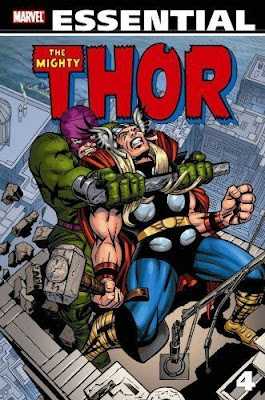
Essential Thor Volume 4.

Essential Thor Volume 4, coverAs I mentioned the other day, I've recently bought a pile of Marvel Essentials and, being the Thor fan that I am, I was never in any doubt which was going to be the first one I read.

Like a good football match, The Essential Thor Volume 4's a game of two halves. The first dominated by the latter days of Jack Kirby, the second by John Buscema, with a well-known guest artist to keep us entertained at half-time.

It all kicks off with Thor sent on a quest to discover the origin of Galactus. Whilst it's good to see Galactus again, his origin turns out to be something of a let down, as we discover he's just some bloke who got exposed to radiation, grew big and started eating everything. By this point we'd seen so many Marvel characters who'd got their start by being exposed to radiation that it all feels way too humdrum an explanation for Marvel's biggest of Big Bads.

Essential Thor Volume 4, Jack Kirby, Karnilla and Balder
Once this tale's done, the remainder of Jack Kirby era spends most its time reworking older stories as we get a rematch with the Wrecker, the Circus of Crime and Ulik. Even the new villain Crypto-Man features in a story that's a fairly blatant rehash of the Replicus tale from issue #141. While these tales are all fun, it's hard to avoid the feeling that, as with The Fantastic Four, by the time he'd left, Kirby's best work on the strip was already waving to him in the rear-view mirror.

As though to prove it, the major storyline of this late Kirby period's a straight reworking of the first Mangog outing when, thanks to getting his hands on the Odin-Ring as Odin sleeps, Loki seizes the throne of Asgard - only for Surtur to inconveniently appear and attack the kingdom. As in the Mangog tale, all seems lost until Odin awakes from his slumbers to dispatch the threat with no noticeable difficulty.

After this is we get an odd little tale - presumably a last minute fill-in - in which John Buscema takes over for an issue to give us Thor versus the Abomination. It's a tale that reveals that Thor can turn back time, which he's never done before and which you would've thought makes him effectively unbeatable.

Jack Kirby returns for just one issue before departing for good, followed by Neal Adams' debut on the strip as Thor and Loki swap bodies in a tale involving Mephisto. I'm not convinced it's a happy debut. It all looks as slick as you'd expect but Joe Sinnott's inks are so distinctive that, however polished it is, it looks more like Rich Buckler's Neal Adams impersonation than it does the real thing. For me it also lacks the dynamism of both Kirby and his long-term successor.

Essential Thor Volume 4, Hela
That successor is John Buscema who returns with a Dr Doom scrap before it's back into epic territory with the tale of Infinity, a star-devouring hand that turns out to be Odin's dodgy side unleashed by Hela.

Happily Infinity's seen off.

Not so happily, Hela's in a bad mood about the foiling of her plans, and kills Thor, only for wimpy old Sif to touch the Death Goddess with her tears, causing Hela to bring him back.

Unfortunately when they all return to Asgard, Loki's got his hands on the Odin-Ring (again) and has seized the throne (again). Instead of giving Loki a good smacking like he should, Odin stays as annoying as ever and goes off to have a kip, leaving Loki to do whatever he wants.

What he wants is to get his leg-over with Sif and create a creature called Durok the Demolisher who spends a fair amount of time knocking Thor around before knocking the Silver Surfer around. Highlight of all this has to be Durok smashing the Surfer's board to pieces. I always liked to see the Surfer suffer.

Essential Thor Volume 4, Hildegarde, first appearance
But there's still no rest for the dunderheaded because, having finally woken up, Odin banishes Loki to the place where Mangog's buried. Needless to say it's not long before the block headed villain releases the monster, and Odin has to thus send our cast off on yet more quests. At this point we meet the Asgardian warrior woman Hildegarde. Hildegarde as a character's great but has one obvious flaw which is that, with her rugged fighting ways, she really does rub-in what a complete and total wet dish-cloth Sif is in comparison.

You can't get away from it that there's an awful lot of repetition going on in these tales, with two reruns of the original Mangog tale and two epics involving Loki taking over Asgard by getting his hands on the Odin-Ring. Just how stupid is Odin that he learns nothing from the earlier problems and still leaves the Odin-Ring lying around for Loki to find? It's also annoying that Odin keeps going into the Odin-Sleep every time he's needed. You really do wonder why the people of Asgard revere the useless old berk.

But there're new ideas too - the main ones being to do with the characters. Freed from the constraints of working with the more concept-oriented Kirby, Stan Lee clearly starts to remodel the strip the way he wants it to be, as grandiose soap opera. This is no bad thing. As the strip goes along it's obvious it's becoming more and more an ensemble piece and less and less a solo strip, as Balder, Volstagg, Fandral and Hogun get more and more page time.

They're not the only ones. Once Gerry Conway takes over the writing chores, there's also the introduction of the strapping Hildegarde, brought in to accompany the increasingly useless Sif on a mission, while, before Lee goes, Hela, rarely seen in the strip before this era, gets noticeably more involvement.

But perhaps the most interesting thing about these tales involves Karnilla the Norn Queen, as we see her gradually evolving from out-and-out villain to a more ambiguous figure, purely through her love for Balder. Balder meanwhile finds himself torn from emotional pillar to post as he tries to balance his love for Karnilla with his sense of duty to Thor, Odin and Asgard. To a large degree, although the comic's called Thor, these are really the adventures of Balder and Karnilla, and the strip's all the better for it.

Tuesday, 16 August 2011

Marvel Essentials.

Essential Amazing Spider-Man Volume 1
Sometime in the late 1990s, I walked into the now-deceased Star Store on Sheffield's Cambridge Street and stumbled across a humble little book on a low shelf. It clearly hadn't been cut right - the cover being marginally smaller than the pages it was meant to be covering.

However, a close inspection revealed it reprinted the first 20-or-so issues of The Amazing Spider-Man - in glorious black and white, just as I remembered them as a child.

Needless to say I had to buy it.

That slightly dog-eared book was of course The Essential Spider-Man and, since then, those mind-controlling villains at Marvel have taken full advantage of my mental weakness by bringing out ever-more Marvel Essentials to prise my money from me. Creaking are my shelves with the weight of Essentials.

Well, there's no fool like an old fool and, still bitten by that bug, I've just gone mad and bought a whole slew more of the things: Thor Volumes 4 and 5, The Avengers Volume 6, and even the first two Captain America Essentials, even though I have no great interest in Captain America.

In terms of consistency my favourite run of Essentials is The Amazing Spider-Man from the start of Steve Ditko all the way through to the end of Ross Andru. The ability of that strip through the first fifteen years of its life to keep improving as it went along's genuinely astonishing and reflects just how strong the central concepts and characters of the title really were.

Essential Avengers Volume 3
My favourite individual volume's probably Essential Avengers Volume 3 with all those Roy Thomas/John Buscema/George Klein tales.

My least favourite so far's been the Essential Killraven which totally failed to engage me despite me having loved the strip as a child. And I can't ignore the fact that Volume 1 of The Incredible Hulk's mostly poor, with even the likes of John Buscema and Gil Kane somehow failing to bring it to life.

Even for one with my addiction to the books, I can't deny there are certain Essentials I'll probably never own. With all the will in the world, I can't see myself ever buying The Essential Human Torch or Essential Ant-Man. However, Essential Sub-Mariner and Captain Marvel are on my future shopping list, as are all the Tomb of Dracula and Defenders books.

All this rambling is of course not done without ulterior motive. It's simply my way of leading up to the big question. Are you a fan of the Marvel Essentials and which have been your favourite and least favourite ones so far?

Thursday, 17 February 2011

How to Draw Comics the Marvel Way. The missing link.

How To Draw Comics The Marvel Way, by Stan Lee and John Buscema
Back in the 1970s, when British television proudly proclaimed itself the best in the world, the biggest star on British TV was arguably a small dog that said, "Sausages," in the voice of Satan whenever its owner manhandled it.

Sadly the days of such quality broadcasting are long since gone but the usefulness of sausages to those involved in the arts remains.

From time to time I've been known to do the odd painting or drawing and I long ago taught myself to draw people by assembling them from hastily sketched sausages before properly defining their shape and detail. So, in the early 1990s, when I saw a copy of Stan Lee and John Buscema's How To Draw Comics The Marvel Way, in my local branch of WH Smiths, I had to buy it.

Disappointingly there wasn't a sausage in sight. In the world of Marvel, it seemed, all was done with stick figures, cubes and cylinders.

Fired up by this new-found knowledge, I had a try at drawing people the recommended way but I can't deny it, by this stage I was too set in my sausagey ways to be able to get the hang of building people up from stick figures, and my attempts to reproduce what Buscema was doing in the book's examples all failed miserably.


I'm also not sure it was written as clearly as it could be. I was never certain whether we were meant to replicate all the construction lines on the heads in the examples or if we were just supposed to imagine them as we drew. As for its claim that the human head is just a cylinder with bits cut off, I always found it better to think of it as an egg that was blunt at both ends. Sausages, eggs; if only I'd been able to work out a way to get bacon into it, maybe I wouldn't have made such a meal of it all.

Still, if the book failed in its principal aim of actually teaching me how to draw, at least I had fun looking at all the art in it and spotting whose work was being used. And I did learn to draw characters with their feet too wide apart, to impose a sense of drama and dynamism.

Sadly, despite its inherent promise of turning us all into John Buscema, as a guide to drawing comics and/or people, I really couldn't claim How To Draw Comics The Marvel Way is the best, or even particularly good. A book I bought around the same time, called Figure Drawing Without A Model by Ron Tiner, as well as having an awful lot more content jam-packed into it, proved far more useful and easier to emulate.

Now if only Marvel had ever had the sense to launch a super-hero called Sausage-Man, then my career in comics would've taken flight.

Wednesday, 10 November 2010

Les Daniels' "Marvel: Five Fabulous Decades of the World's Greatest Comics"

Les Daniels, Marvel: Five Fabulous Decades of the World's Greatest Comics, John Romita cover
When I bought this book, eighteen years ago, I wasn't too sure what it was called. Was it called Marvel or was it called Five Fabulous Decades of the World's Greatest Comics? Was it called both? After much thought, I've decided it's called Marvel, as that's what it says on the cover, in great big letters. I might be slow but I get there in the end.

But, "in the end," is all that matters and, in the end, the title doesn't. What matters is that after the mid-1980s, I stopped reading American comics - or in fact comics of any variety. I could claim it was because I was too grown-up to read them but the truth is I was just too lazy to buy them. However, even I must shake myself out of my sloth sometimes and, by the early 1990s, my sense of nostalgia'd grown sufficiently to motivate me to dip the occasional toe back into those four-coloured waters.

This meant Les Daniels' Marvel came out at exactly the right time. It meant I could acquaint myself with the company's entire history in one great big go, while looking at lots of pretty pictures and reading about my favourite characters. At the time, pretty much all I knew about Marvel's back-story had come from Stan Lee's not totally impartial  Origins of Marvel Comics books and so I didn't even know the company had come close to financial ruin even as I'd been reading those books.

Les Daniels' tome isn't perfect. While it's certainly not a hagiography, it is clearly an authorised biography and, while it acknowledges the more controversial elements of Marvel's history, it tends to only lightly touch on them. I don't personally mind that the whole Kirby vs Lee, Ditko vs Lee, disputes are only briefly dealt with. Frankly I long since grew tired of hearing Kirby vs Lee vs Ditko vs Whoever arguments and it's a blessed relief to escape them here.

Where the book does suffer from its reluctance to rock the boat is in its coverage of the Jim Shooter years. The only acknowledgement that his reign as Editor in Chief might not have been greeted with universal love by his underlings is the statement that he, "may have stepped on a few toes." At the time, I knew nothing of the Shooter story and didn't realise just how much of an understatement that was. It has to be said that Jim Shooter's fall-out with what seems to have been virtually the entire comics industry is a tale so epic it deserves it's own multi-part cross-over, let alone proper coverage in a book detailing Marvel's history. In the book, Stan Lee describes Shooter as, "Competent and hard-working." Given how effusive Lee usually is when describing people - or indeed anything - "Competent and hard-working," sounds suspiciously like the closest thing to damning with faint praise you'll ever get from the great man's lips.

As for the rest, once the history lesson's over, we get a piece telling us how a Marvel comic's put together and then we get a number of key stories from the company's history, reprinted. We get Fantastic Four issue #51 and Amazing Spider-Man issue #2. There's also an early Sub-Mariner tale and a Wolverine story. In what way the Wolverine tale's historically important, I've no idea. It just looks like another story to me. I suspect it's there purely because Wolverine's popular and so they were determined to crowbar him in somehow, but it features Wolvie vs some mandroids, so, if you like to see mandroids get hacked to death by an angry man who's just been shot full of bullets, you'll probably be delighted.

Such quibbles aside, it's simply a great book to read, bombarding the reader with classic images, panels and pages from the company's history, putting it all in chronological order and getting interviews with the luminaries we all grew up loving. It's probably of limited use to someone doing serious research into the back-room shenanigans at Marvel over the years but, for the fan, it's a great thick wallow in nostalgia and, let's face it, if we weren't fans, we wouldn't be reading it.