Thanks to Charlie Horse 47 and Killdumpster for their sponsorship of this post, via the magic of Patreon.
***

I admit it. I've always wanted to live on the 51st floor of a skyscraper that, officially, has only 50 floors.
That's because I want to be like the Shadow, and that's the sort of thing the Shadow would do.
Sadly, there are no 50 storey buildings in my native city. So, I shall have to settle for living on the first and second floors of a building that only officially has two floors. Surely such a ruse cannot fail to fool the dregs of the criminal underworld.
But that brings me back to the Shadow's short-lived 1970s DC series.
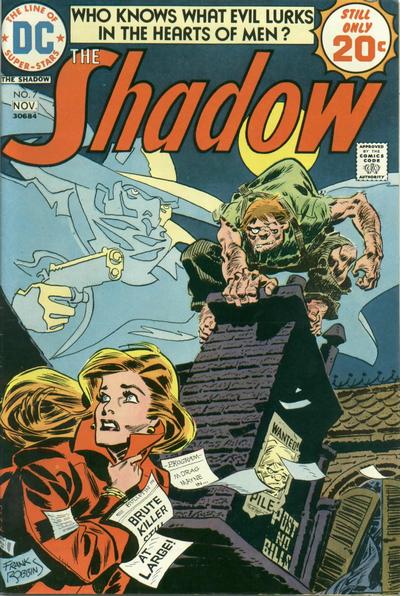
As we all know, it started off being drawn, with great style, by Mike Kaluta. However, after less than half-dozen issues, Michael Wm left the strip and it was handed over, for three issues, to the ever-popular Frank Robbins before ER Cruz was set loose on it.
There's one thing we know about Frank Robbins and that's that his style always made everything look like it was set in the 1930s, even when a story was set in the 1970s. So, just how did that style cope with drawing the 1930s themselves?

Before anyone can react, Pile swings in on a rope and makes off with the lovely Morag.
But it's mere moments before Cranston's transformed himself into the Shadow and gives chase.
Sadly, Shads isn't the only one giving chase, because so are a couple of hoods who see-off Pile, in the street outside, before the Shadow shows up and sees them off.

Thus it is that, while the Shadow and Morag are snogging in her apartment, the still-living Pile reappears, sends the Shadow flying and, again, abducts Morag, this time heading for his former home in an abandoned brewery.

Obviously, this results in plenty of shooting, punching and needless laughing and, at the end of it all, Joey's been decked by the Shadow, while Pile, already mortally wounded by Joey's men, is accidentally killed by Morag, using the gun Pile himself gave her. Oh, the bitter irony of it all.
Denny O'Neil's tale's not a complex one. In fact, it's basically a hodgepodge of 1930s cliches, with a large chunk of The Hunchback of Notre Dame flung in but it has an irresistible sense of style, keeps moving and is a painless read which allows Robbins to do what he does best, which is avoiding drawing things that look new.

So, yes, it's true. Under the right circumstances, even Frank Robbins' work can appeal to me.
But a thought's just re-entered my head. One which struck me, way back then. The Shadow wears a scarf and a hat and has a sidekick called Harry.
When he first appeared, Tom Baker's Doctor also wore a scarf and a hat and had a sidekick called Harry.
Was this pure coincidence or was there a long-unacknowledged influence going on?
I don't know.
But the Shadow probably does.






 Posts
Posts