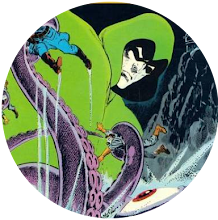
Inspired by the Black Panther's appearance in the trailer for Captain America's Civil War movie, which has just been unleashed upon the world, I thought I'd do a review of the first instalment of Panther's Rage, the saga that filled the pages of Jungle Action for almost a year in the 1970s.
The series made a huge impact on me when I first read it reprinted in Marvel UK's Planet of the Apes and it was probably my favourite ever comic book storyline when I was a youth.
Unfortunately, my attempt at doing a normal review of it was a total disaster. So, instead, I thought I'd try a different tack and break it all down to its bare essentials.
So, here goes.
Plot:
The Panther returns to Wakanda after a lengthy absence, super-heroing in America with the Avengers.
Upon returning, he finds that many of his subjects resent him for his absence and now doubt that he's capable of leading his country any more.
To make matters worse, civil war's broken out in his kingdom's extremities and a ruthless giant of a man called Erik Killmonger is out to overthrow him.
What's good about this issue:
Rich Buckler draws it like he's capable of drawing it, instead of drawing it like he's Jack Kirby with a broken arm, which means it looks great.
There's plenty of conflict between the characters.
Don McGregor gives us his determination to make comics more grown-up but, for now, avoids the over-verbosity that can drag his writing down when it goes into overdrive.
Nothing's black and white. The Panther may be the tale's hero but there's no doubt he's ignored his responsibilities to his country and his people and is at least partially to blame for what's happening.
Erik Killmonger's a genuinely menacing villain and clearly physically too much for our hero to handle.
The Black Panther gets to fight a leopard.
What's bad about it:
The Panther's American girlfriend Monica Lynne is spectacularly annoying and insists on calling T'Challa, "Ta-Charlie," which is the sort of thing you could imagine the Thing calling him. In fact, the Thing probably did call him that at some point. It makes me wonder if, next issue, she'll start to declare, "It's clobbering time!" at every opportunity.
W'Kabi, T'Challa's head of security, has clearly taken belly-aching lessons from Killraven's Hawk and spends the entire issue griping to the Panther about how he's let his country down and that he's probably not fit to rule it anymore. He really is the biggest wet blanket you've ever met and, as far as I can remember, he manages to keep his world-class complaining going all the way through the series. How he manages to keep his job is anyone's guess. The Panther must have the patience of a saint.
Tayete and Kazibe, Killmonger's two henchmen, quickly become portrayed as hapless and almost endearing comic-relief characters, even though they're ruthless killers. It's a shift in tone that feels somewhat uncomfortable, bearing in mind that we first encounter them torturing an old man to death.
The tale's too short. It's only thirteen pages. The thing's over almost as soon as it's started. Fortunately, that failing's resolved in later issues, with the strip expanding to completely fill the book.
The verdict:
Overall, it's a strong introductory episode. It looks good, it has a great moodiness to it, quickly gets us up to speed as to what's happening, introduces the major players and conflicts and features more of McGregor's strengths than his weaknesses. There's really little to hint at the strangeness and the ambition of what's to come but there's enough in it to make you know it's not going to be a typical super-hero strip. I can understand why I loved it as a youth, even though I can see its flaws as an adult.
Showing posts with label Jungle Action. Show all posts
Wednesday, 25 November 2015
Thursday, 22 April 2010
Jungle-Action #15. The Black Panther gets the point.
If Johnny Rotten was right and he was the Anti-Christ, it strikes me that Don McGregor is the Anti-Kirby. Here, Jungle Action #15, he gives us the exact same concepts as Kirby would but approaches them from exactly the opposite direction.Just as Kirby would've done, he gives us the Black Panther using a pterodactyl as a kind of airborne surfboard. Just like Kirby, he gives us, in King Cadaver, a man shrunken by radiation but gaining a giant head. And , of course, we get the issue's villain of the piece, who Kirby would no doubt have labelled Cactus Man.
Cactus Man; you can just see him stalking the pages of the Kirby Panther comic, with his powers of a cactus. But, whereas with Kirby, it would all have been an escapist romp with no emotional consequences for its protagonist, here, every page, every panel, is a feat of endurance for the characters (and occasionally the reader). This isn't Cactus Man, this is K'Ruel, and the whole tale lives up to that sobriquet as T'Challa is shot at with napalm, penetrated by a thousand spikes, left tied-up out in the sun, attacked by a pterodactyl and dropped from the sky towards a jungle of thorns. He's not the only one suffering. In the interludes, we get to visit the supporting cast, all of whom are having a tough time of it.
The days when Wakanda's main worry was a man who can't spell the word "claw" are long gone. Under McGregor's stewardship, the forces of revolution have risen against our hero. Because it's Don McGregor, the Panther isn't totally right and the bad guys aren't totally wrong. In fact, some could argue the Panther is completely wrong.
He's been wrong to spend all his time in America, having adventures with the Avengers, and neglecting his own kingdom. He's been wrong in failing to have ever asked his people if they actually want the brave new Wakanda he's created around them. Because it's Don McGregor, we know this because he tells us, using lots and lots and lots of words. Possibly the worst part of the story for this is where the Panther's American squeeze Monica Lynne visits some of the locals and promptly goes off on a long speech about plates that really makes no sense. Even McGregor seems to acknowledge this as the old woman Karota totally fails to understand the point she's trying to make.
It'd be interesting to see a Don McGregor synopsis. I'm used to hearing Stan Lee talk of the "Marvel Method" and how he'd often give an artist only a rough outline - or even just a sentence - and then leave him to get on with it, and how this became the standard practice for all writers at Marvel. But that can't be how McGregor did it, can it? The way Billy Graham's visual story-telling works in this tale's so similar to how Craig Russell's worked in Killraven that I assume McGregor must have given his artist something altogether more detailed to chew on. Graham's work seems darker, more visceral, than Russell's, with none of the light touches Russell would throw in, but the use of flashbacks, the pacing and the interludes is remarkably similar.
On re-reading, I think I prefer this to the Killraven story I reviewed a bit back. It has all the same flaws as that but, somehow, the moral ambiguities of a rebellion against a super-hero king who spends most of his time in another country and has made no attempt to listen to his people, seems to lend itself better to McGregor's style. It's still not perfect. Too many words, too little structure, too many cut-aways to other scenes that add nothing to the story. But, as with Killraven, it's wrong to dismiss it out of hand - even if you're not sure you're ever going to be able to make the effort that it'd take to read it again.
Labels:
Black Panther,
Jungle Action
Subscribe to:
Posts (Atom)