 I suppose it’s a sign of how far Marvel UK’s flagship title Mighty World of Marvel had drifted away from its roots that the 1978 annual of that name doesn’t feature any of the characters you actually associate with it.
By then, in the weekly mags, Spider-Man was long gone and the Fantastic Four’d been shunted around all over the place, having been moved to The Titans then to Captain Britain then to their own comic before eventually heading back to The Mighty World of Marvel. On top of that, the likes of Conan, Dracula, Sgt Fury, the Avengers, X-Men and even Planet of the Apes had had their spells in the comic.
And so it is that, despite the cover showing long-standing Mighty World of Marvel favourites Daredevil and the Hulk, inside we get Captain Marvel and Luke Cage.
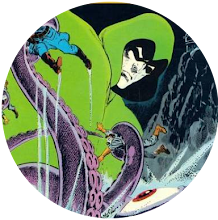
The 1978 annual gives us just two tales. In the first, Captain Marvel - having been trapped in the Negative Zone - gets to swap atoms with Rick Jones so they can take each other’s place in this world.
The 1978 annual gives us just two tales. In the first, Captain Marvel - having been trapped in the Negative Zone - gets to swap atoms with Rick Jones so they can take each other’s place in this world.
I’ve never really been sure why the decision was made to bring together Rick Jones and Captain Marvel. They don’t seem a natural fit and I’m not sure the strip really gained anything from it. It’s easy to see why Captain Marvel’s there but not why Rick Jones is. Maybe it was just Roy Thomas trying to find a new use for a character who’d tended to be a spare cog wherever he’d shown up or maybe it was him trying to emulate the Billy Batson/Original Captain Marvel set-up. Either way it meant Jones was now a spare cog actively built into the structure of a comic rather than just being tacked on which maybe gave him a greater sense of importance but also gave him a greater potential to be an irritant.
Still, it’s an atmospheric tale as stylishly drawn as ever by Gil Kane, though let down towards its climax by the appearance of a dull villain in the shape of the murderous Yon-Rogg. There’s also an exploding Carol Danvers, an idea the less said about which the better.
In the second tale, Luke Cage goes to Japan where he encounters a megalomaniac with a base in a volcano. I think we can guess which movie Chris Claremont’d been watching before he came up with this tale and it does indeed feel suspiciously like a James Bond flick as Moses Magnum tries to drill to the Earth’s core, paying no heed to the fact it’ll set off a series of earthquakes that’ll destroy large chunks of the globe.
Exactly why he wants to do this isn’t clear. Apparently he wants to get his hands on the magma so he’ll be rich. Maybe it’s me but I wasn’t aware of any major global trade in magma. I’m also not convinced the market for it’ll be all that great if half the world - and its economy - has just been destroyed.
In truth it’s a tale that doesn’t really make a lot of sense all round. It’s hard to see why Magnum’s doing what he’s doing at any point in the tale, nor where the character Sam Sheridan, who’s some sort of seismologist/geologist, fits into it all. One moment Magnum wants her alive, then he wants her dead. One moment he wants her advice on how safe what he’s doing is, the next he’s totally ignoring that advice.
In the end, none of it matters as Magnum’s killed when his drilling laser causes his volcano base to blow up, meaning Luke Cage never actually needed to have turned up in the first place. It’s quite a long tale but rarely an interesting one and I do have the problem that Cage is written in such a way that, whenever I read his dialogue, I hear him speaking with the voice of Hong Kong Phooey.
This was the last UK Marvel annual I ever had. After reading it I decided that if it didn’t have the big-hitters like the Hulk and the FF, and only had two stories, it just wasn’t worth bothering with anymore. It’s a shame because, like a lot of people my age, Mighty World of Marvel had been my main inculcation into the ways of Marvel. The weekly comic itself still had some life in it but, not much more than a year later, Dez Skinn’s editorship made that too a shadow of its former self. Maybe the 1978 Mighty World of Marvel annual at least did us that service of preparing us psychologically for the once-unthinkable time when Marvel UK’s greatest title was no longer worth buying.
Still, it’s an atmospheric tale as stylishly drawn as ever by Gil Kane, though let down towards its climax by the appearance of a dull villain in the shape of the murderous Yon-Rogg. There’s also an exploding Carol Danvers, an idea the less said about which the better.
In the second tale, Luke Cage goes to Japan where he encounters a megalomaniac with a base in a volcano. I think we can guess which movie Chris Claremont’d been watching before he came up with this tale and it does indeed feel suspiciously like a James Bond flick as Moses Magnum tries to drill to the Earth’s core, paying no heed to the fact it’ll set off a series of earthquakes that’ll destroy large chunks of the globe.
Exactly why he wants to do this isn’t clear. Apparently he wants to get his hands on the magma so he’ll be rich. Maybe it’s me but I wasn’t aware of any major global trade in magma. I’m also not convinced the market for it’ll be all that great if half the world - and its economy - has just been destroyed.
In truth it’s a tale that doesn’t really make a lot of sense all round. It’s hard to see why Magnum’s doing what he’s doing at any point in the tale, nor where the character Sam Sheridan, who’s some sort of seismologist/geologist, fits into it all. One moment Magnum wants her alive, then he wants her dead. One moment he wants her advice on how safe what he’s doing is, the next he’s totally ignoring that advice.
In the end, none of it matters as Magnum’s killed when his drilling laser causes his volcano base to blow up, meaning Luke Cage never actually needed to have turned up in the first place. It’s quite a long tale but rarely an interesting one and I do have the problem that Cage is written in such a way that, whenever I read his dialogue, I hear him speaking with the voice of Hong Kong Phooey.
This was the last UK Marvel annual I ever had. After reading it I decided that if it didn’t have the big-hitters like the Hulk and the FF, and only had two stories, it just wasn’t worth bothering with anymore. It’s a shame because, like a lot of people my age, Mighty World of Marvel had been my main inculcation into the ways of Marvel. The weekly comic itself still had some life in it but, not much more than a year later, Dez Skinn’s editorship made that too a shadow of its former self. Maybe the 1978 Mighty World of Marvel annual at least did us that service of preparing us psychologically for the once-unthinkable time when Marvel UK’s greatest title was no longer worth buying.


 Posts
Posts





%20000.jpg)


