
On the face of it, bearing in mind this is meant to be an Avengers tale, that might seem perverse but, when we look at the whole thing in perspective, it becomes clear that, like the addressee in Billy Paul's version of Wings' Let 'Em In, we've been took, we've been had.
We can see that Roy Thomas hasn't been writing an Avengers tale at all. He's been writing a Captain Marvel tale and, because the Captain's own mag had been cancelled, Thomas had simply staged it in the Avengers' comic instead. That's why the epic kicks off with Captain Marvel and closes off with Rick Jones.
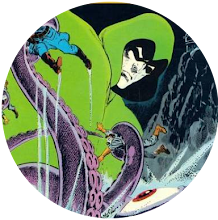
Finding himself trapped in the Negative Zone, it looks like it's worse than curtains for Rick, it's roller blinds, shutters and louvres all packed into one, until he discovers he can fire mind-beams from his brain that see off the threat of Annihilus.
Now Rick discovers he can fly though the Negative Zone purely by the power of thought. This brings him back to the Kree homeworld where he wills a bunch of Golden Age Marvel heroes into life to delay Ronan and his guards for long enough to send out another mind beam - via Captain Marvel - that immobilises the whole of the Kree and Skrull galaxies. We're told by the Intelligence Supreme that Captain Marvel's attempt to contact Rick and the Avengers through his Omni-Wave transmitter's released the latent psychic power in Rick that all humans possess. The only problem is this has proven too much for Rick to handle and Captain Marvel has to once again merge with him in order to save his life. So, the thing's gone full circle. It began with Mar-Vell and Rick Jones separating and ends with them reuniting.
It's interesting that the saga's run coincided with Marvel becoming America's biggest comic book publisher, seeing as the whole thing can be seen as a celebration of the company's history - from the Golden Age through the Silver and into the Bronze. With its incorporation of characters from throughout the company's various incarnations, the saga is in some ways the equivalent of those old Soviet May Day parades where the might of the Red Army'd be wheeled out and showcased for the world to see. If anyone was in any doubt that Marvel deserved its place as the new big kid on the block, the Kree/Skrull War seemed purpose-built to crush such thoughts. And when the Intelligence Supreme talks of the Kree and Skrull having stalled on the evolutionary ladder and hating the human race because they know deep down that, with its greater dynamism and ability to adapt, the human race is ultimately their superior, from Marvel's viewpoint he might as well have replaced the words "Kree" and "Skrull" with the letters "D" and "C".
So that's it. With a nine-part epic drawn by two of the artists most associated with Marvel's Silver and Bronze Age dominance and one previously poached from their rivals, Marvel had planted their flag at the summit of Mount Comic Book, a place they weren't in any hurry to concede.
The main downside of the issue is that Neal Adams - the artist most associated with the saga - isn't here to see it through but, apparently, deadline problems meant John Buscema had to step in to finish it off. It means the climax isn't as visually ambitious as it might've been - Buscema for the most part giving us good solid story-telling and sometimes stock poses rather than daring innovation but, given that the story centres around the company's history and, given Buscema's presence in a large chunk of Avengers history, it is perhaps appropriate he should cap off its first true epic.


 Posts
Posts





%20000.jpg)


