I don't think it takes a master psychologist to work out the reason I inflict this blog on the world is nostalgia for a time long past, a time so much better than we have now, one where we had loads of great things kids today can only dream of. We had oil shortages, paper shortages, sugar shortages, toilet roll shortages, sugar shortages and tea shortages. We had Love Thy Neighbour on our TVs, Robin Askwith in our cinemas and an eighteen month wait for a telephone. It was a time when, to save electricity (of which there was a shortage), the TV companies took to only broadcasting the middle third of the picture, meaning we only ever got to see the actors' midriffs. And, of course, at one point even the days ran out and we had to have three day weeks. Although we gave them up, to my knowledge we never got the sacrificed days back, meaning the government must, even now, have a day-of-the week stockpile from the early 1970s that it's refusing to release.
Highlight of this era had to be that dread year when it was all over the news there'd be no toys for Christmas because the country'd run out of that scarcest of resources plastic. Happily, not for the last time, the media were lying to us and there were indeed toys that Christmas.
But it's not all tea and crumpets when it comes to the past. Why? Because the past has one big failing.
Murkiness.
That's what today's appeal is all about. Like Blue Peter appealing for your unwanted socks and plugs, I'm asking for information in the hope you can help me identify some of the earliest American comics I ever bought. This was long before I started collecting them, and, after reading them a couple of times, I'd merrily throw them in the bin. Sadly, the bin shortage that would've prevented this never happened.
Needless to say the gods have punished my recklessness by taking away my memories of what exactly some of these comics were. So, if anyone can ID the following issues, I'd love to hear from you.
The first - and probably earliest - is a Superman comic from a jumble sale at my local community centre. It didn't even have a cover, which doesn't exactly help when it comes to me identifying it. All I remember about it, apart from Superman being in it, was that at one point, for some reason, Lois Lane hides in a piano. I'd have got it, I think, in the very early 1970s but, as it was clearly second-hand, it could've come from several years before then.
Next is an issue of The Flash that begins with a heftily major reference to Jerry Lee Lewis who I'd never heard of. I must come clean and admit that, at the time, I thought it meant the comedian of a notably similar name. It may also have involved an incident on a roller coaster. I bought this in summer 1972.
Next there's a Batman comic. All I remember is that, at one point, Batman throws some Bolas at someone. This was the first time (and possibly last) I'd ever heard the word "bolas". Granted, this isn't a lot to go on but if anyone has any ideas what it might be, I'd love to hear them. Again, I got this in the summer of 1972.
An issue of the Teen Titans in which they have a caveman in the back of a van. At the end of the tale, the caveman bursts out of the back of the van, no doubt causing all manner of trouble in the following issue. Yet another bought in summer 1972. (NB: I 've now located, acquired and reviewed this comic - Teen Titans #33.)
Finally, an issue of either the Justice League or Justice Society of America in which some (though possibly not all) of the team finish the tale on an alien planet, in a cave, looking out at the sun, which may or may not have been setting. Dr Fate may have been in it and I think this may have come into my possession in the autumn of 1972.
Granted some of these tales may be easier to recognise than others and I can't guarantee my memories are as accurate as they could be but if anyone can fill me in I'd be delighted to hear from you.
By the way, while I'm here, for our British readers, I recall a children's TV show from the late 1960s that starred two Scottish comedians, one of whom often played the mother of the other. The "Mother" seemed to have a catchphrase of, "I don't know what to say," which she'd utter while doing things like cutting bread. I remember them being mentioned on 5-Live about ten years ago but was so excited to discover I wasn't the only one who remembered them that I promptly forgot their names again. If you know what they were called, I'd not only be amazed but happy to hear from you.
Saturday, 17 July 2010
Wednesday, 14 July 2010
Strange Adventures #242. Adam Strange in a not so strange land.
When I was a kid, I used to tie washing-up liquid bottles to my back, jump up and down and pretend to be an astronaut. I can't deny astronauts aren't in the habit of strapping washing-up liquid bottles to their back, and so this made no sense but still I did it.
Happily I'm not alone, as interplanetary adventurer Adam Strange seems to have had the same idea.
The truth is I don't know a lot about Adam Strange. This is the only comic I ever had that features him but the story inside seems to be well remembered, as I randomly switched on my TV a few months back and caught a Justice League type cartoon that recycled its plot.
A mad scientist with a giant magnifying glass is threatening to destroy cities on the planet Rann. Just to prove all scientists need a slap, back on Earth, another one's threatening to destroy cities, with planes he's stolen from the future. In the end, our intrepid hero uses the magnifying glass to thwart the planes, and everyone's happy apart from the scientists.
The main thing that strikes me about this tale is how good it looks. Drawn by Carmine Infantino - known always to me as that bloke with the cigar in the huge Superman meets Spider-Man comic - it's from 1963 and, when I think how Marvel comics from that era look, it's clearly a whole lot more sophisticated, both in terms of art and writing.
Of course, it could also be argued, it's less bursting with vigour than those titles but somehow that doesn't make it any less pleasing. There's an odd kind of almost peaceful elegance about it that makes it one of the most fondly remembered comics of my childhood and, even as an adult, I can appreciate it, which isn't always the case with stories of its age.
The comic also features a back-up tale, yet another early 1960s reprint, one that you know must have turned up in an Alan Class comic at some point. A pair of time agents turn up in the present to prevent a man starting his car. Thanks to highly unlikely science, the act of starting his car'll cause a catastrophe that'll set the human race back 100,000 years. There's a twist at the end that I didn't see coming, mostly because you'd have to be psychic to see it coming. All in all, the tale's a bit lame but whoever said lameness had to be a bad thing?
Happily I'm not alone, as interplanetary adventurer Adam Strange seems to have had the same idea.
The truth is I don't know a lot about Adam Strange. This is the only comic I ever had that features him but the story inside seems to be well remembered, as I randomly switched on my TV a few months back and caught a Justice League type cartoon that recycled its plot.A mad scientist with a giant magnifying glass is threatening to destroy cities on the planet Rann. Just to prove all scientists need a slap, back on Earth, another one's threatening to destroy cities, with planes he's stolen from the future. In the end, our intrepid hero uses the magnifying glass to thwart the planes, and everyone's happy apart from the scientists.
The main thing that strikes me about this tale is how good it looks. Drawn by Carmine Infantino - known always to me as that bloke with the cigar in the huge Superman meets Spider-Man comic - it's from 1963 and, when I think how Marvel comics from that era look, it's clearly a whole lot more sophisticated, both in terms of art and writing.
Of course, it could also be argued, it's less bursting with vigour than those titles but somehow that doesn't make it any less pleasing. There's an odd kind of almost peaceful elegance about it that makes it one of the most fondly remembered comics of my childhood and, even as an adult, I can appreciate it, which isn't always the case with stories of its age.
The comic also features a back-up tale, yet another early 1960s reprint, one that you know must have turned up in an Alan Class comic at some point. A pair of time agents turn up in the present to prevent a man starting his car. Thanks to highly unlikely science, the act of starting his car'll cause a catastrophe that'll set the human race back 100,000 years. There's a twist at the end that I didn't see coming, mostly because you'd have to be psychic to see it coming. All in all, the tale's a bit lame but whoever said lameness had to be a bad thing?
Labels:
Adam Strange,
Strange Adventures
Tuesday, 13 July 2010
Conan the Barbarian #67. Red Sonja vs Belit
If there's three people you wouldn't let loose in your local library, it's Conan, Belit and Red Sonja, as all three quickly reveal themselves willing to kill just to get their hands on one page of one book. Blimey, what'd they do for a whole copy of Harry Potter?Sadly, however, it's not reading they're interested in. It's money. The page is from the legendary Book of Skelos and is thus worth a bucketful of cash to whoever gets their hands on it. Thanks to this - and them being typical, immature, petty and over-emotional females - we get the clash we've all been crying out for; Red Sonja vs Belit.
Well, admittedly, I've not been crying out for it, I'd be more interested in Sonja vs Valeria, who Sonja was clearly a bit of a rip-off of. But, still, beggars can't be choosers. When the clash comes, Sonja easily wins their battle with swords and we never get to see who's handier with a knife, as Sonja's more interested in stealing the page she came here for than continuing the fight. You suspect writer Roy Thomas couldn't really bring himself to admit that professional warrior Sonja would flatten her more rustic rival.
Despite being nicely drawn (but poorly inked) - and Sonja being quite cool, easily outwitting Conan and Belit, and happy to hang around in sewers - it's an odd tale that doesn't seem too sure what it's actually about. Its "A" Plot's quickly discarded in favour of a side-track in which Conan sets about breaking his old mate Yusef from prison. At the end of this diversion, there's a tacked-on and frankly ludicrous panel in which we're told that, while Yusef was in his dungeon, he found his way into the next cell, in which he met the man who stole the page and brought it here in the first place. It's clearly an attempt by either Thomas or Buscema to tie this otherwise irrelevant strand into the main plot but, as it doesn't advance either the plot or our knowledge of what's going on, it fails miserably.
Accusations of sexism have been flung at Roy Thomas over the years and this issue doesn't help, as Sonja and Belit, being typical wenches, can't get through a simple conversation without a cat-fight breaking out, and Tara of Hanumar who was introduced a few issues back as a live-wire tomboy is now, thanks to pregnancy, reduced to spectator status.
Then again, Sonja and Belit's behaviour, while immature and petty, is undeniably in character for both of them, so at least you can make some excuses for Thomas there. Having said that, of course, he was the one who gave them immature and petty personalities in the first place.
Maybe it's just me but the choice of cover for the issue's odd. Leaving aside that the Tara on the cover bears no resemblance to the Tara inside it, and is clearly just the helpless girlie who turns up on the front of every issue, and that nothing on the cover actually happens in the story, you'd have thought Sonja vs Belit, as the main selling-point of the tale, would've been the thing to make the mag's front.
Finally, are they sure about Conan's legendary battle-sharpened senses? Most mind-boggling scene is when Conan completely fails to notice, for panel after panel, that Tara's pregnant, despite her sporting a bump the size of Neptune.
Friday, 9 July 2010
Superboy and the Legion of Super-Heroes #204
When I was a kid, my dad wouldn't let me use his Time-Scanner in case its rays inadvertently changed the course of history.
Sadly, the father of the character we know only as Anti-Lad lacks that wisdom and so, while using the device in his 75th Century home, to view Superboy's audition to join the 30th Century Legion of Super-Heroes, Anti-Lad finds that something's gone wrong and, thanks to the malfunctioning scanner, Superboy's failed the try-out. Needless to say this potentially disastrous turn of events has to be put right before the whole universe is thrown into chaos.
Fortunately Anti-lad's dad's as irresponsible with his Time Machine as he is with his Time Scanner and so the youth goes back in time to make the Legion thinks he sabotaged Superboy's big break, so they'll give the kid from Krypton another chance. Strangest moment in the tale comes when Anti-Lad breaks the fourth wall, at its conclusion, and directly addresses the reader for purposes of exposition.
It's a nice, frothy, throw-away tale with zero drama, and totally avoids the obvious question as to whether it's now canon that Superboy failed his first attempt to join the Legion. It's also as slickly drawn as you'd expect by Mike Grell whose 75th Century costumes give a whole new meaning to the word camp.
But The Legionnaire Nobody Remembered is only the warm up to a genuinely strange tale in which Brainiac 5 builds himself a robot Supergirl to meet his romantic "needs." Unfortunately for him, one of his needs turns out to be protection against a deadly belt of radiation the genius has managed to fly his spaceship straight into. Fortunately for him, at that very moment, the real Supergirl turns up and saves him.
Having found out what he's done, Supergirl, instead of taking out an injunction, then plays eight rounds of tonsil tennis with him. Leaving aside the mind-boggling coincidence that, after years of being a Legionnaire no-show, Supergirl just happens to turn up in the 30th Century at the exact moment she's needed, her total lack of concern that Brainiac's built a robot replica of her to service his "needs" seems very odd and therefore makes the tale a worthy successor to all those older tales where Supergirl would fall in love with her horse or search the universe in an attempt to find Superman a girlfriend who looked exactly like herself. I can't say I like the story - even when I was a kid it seemed creepy - and the usually stylish Mike Grell really doesn't draw an attractive Supergirl, making her look like she's dressed entirely in nylon. Then again, she's from the 1970s in this tale, so maybe she is.
PS. Yet another Steve Does Comics No-Prize goes to the first person to point out the obvious blooper on the front cover.
Sadly, the father of the character we know only as Anti-Lad lacks that wisdom and so, while using the device in his 75th Century home, to view Superboy's audition to join the 30th Century Legion of Super-Heroes, Anti-Lad finds that something's gone wrong and, thanks to the malfunctioning scanner, Superboy's failed the try-out. Needless to say this potentially disastrous turn of events has to be put right before the whole universe is thrown into chaos.
Fortunately Anti-lad's dad's as irresponsible with his Time Machine as he is with his Time Scanner and so the youth goes back in time to make the Legion thinks he sabotaged Superboy's big break, so they'll give the kid from Krypton another chance. Strangest moment in the tale comes when Anti-Lad breaks the fourth wall, at its conclusion, and directly addresses the reader for purposes of exposition.
But The Legionnaire Nobody Remembered is only the warm up to a genuinely strange tale in which Brainiac 5 builds himself a robot Supergirl to meet his romantic "needs." Unfortunately for him, one of his needs turns out to be protection against a deadly belt of radiation the genius has managed to fly his spaceship straight into. Fortunately for him, at that very moment, the real Supergirl turns up and saves him.
Having found out what he's done, Supergirl, instead of taking out an injunction, then plays eight rounds of tonsil tennis with him. Leaving aside the mind-boggling coincidence that, after years of being a Legionnaire no-show, Supergirl just happens to turn up in the 30th Century at the exact moment she's needed, her total lack of concern that Brainiac's built a robot replica of her to service his "needs" seems very odd and therefore makes the tale a worthy successor to all those older tales where Supergirl would fall in love with her horse or search the universe in an attempt to find Superman a girlfriend who looked exactly like herself. I can't say I like the story - even when I was a kid it seemed creepy - and the usually stylish Mike Grell really doesn't draw an attractive Supergirl, making her look like she's dressed entirely in nylon. Then again, she's from the 1970s in this tale, so maybe she is.
PS. Yet another Steve Does Comics No-Prize goes to the first person to point out the obvious blooper on the front cover.
Labels:
Legion of Super-Heroes,
Superboy,
Supergirl
Wednesday, 7 July 2010
The Creepy Worlds of Alan Class.
If there's anything I associate with childhood coach trips it's the competition to see who could be the first to spot a sheep. Sadly, as my sheep-spotting blog's yet to take shape, I'll have to talk about the other thing I associate with such journeys, and that's Alan Class. For some of us, no 1970s' coach trip was complete without first stopping off to buy at least two or three of the things to read on the journey.Of course, at the time I didn't know the odd-looking comics were published by Alan Class. I didn't find out who he was until the early 1990s when I saw an article about him and his work in the now long-defunct Comic World magazine but, with their short, fat pages and black and white reprints of what were obviously ancient tales, I knew such books must all be the product of one company.
Where those reprints came from was anyone's guess, as Alan Class comics weren't dated and gave no copyright information whatsoever. Some weren't even numbered, bearing instead mysterious letters to signify who-knew-what?
We kick off with a thief who, fleeing the cops, hides in a museum. When he recognises everything in the display room, he concludes that in a past life he must've been the famously nice pharaoh who's on display and, realising what a good person he once was, gives himself up. The twist at the end of this tale's great as we find out he's got it completely wrong and, as a child, he was once trapped overnight in the same exhibition room, becoming so traumatised by the experience that it turned him bad. Apparently it'd taken his psychiatrists years to help him forget about it.
Next, a witch takes revenge on a bunch of pirates who killed her husband, by shrinking them down and putting them in cages. It's a nicely macabre tale of the type I always associate with Alan Class, let down only by a lame last panel.
In a tale that feels like pure Stan Lee - although no writer's credited - a Western scientist's kidnapped by that well-known communist state of Uralia and forced to create for them the ultimate weapon. Needless to say he then uses the weapon to deliver them to justice - ie, the West. For some reason everyone in Uralia has a sign hanging from his neck featuring what's presumably the nation's symbol.
Next is a story of pure bafflement. After getting too big for its boots, the Earth's trapped in an ice age, dying, after all the other planets in the solar system ganged up on it and attacked it in an act of preemptive self-defence. Now the survivors contemplate whether to invade a planet in a far-off solar system in order to save themselves. When they vote no, the sun comes out, the ice age at an end. It seems God's rewarding them for doing the right thing, although it's never actually stated. I suspect it's the sort of tale that would've gone down better in 1950s America than in the more cynical land of 1970s Britain.
In our next story, a criminal takes refuge in a lab and decides to escape justice by using the matter transporter he finds there. The twist is that it's not a matter transporter at all. It's a time machine and he finds himself trapped in the age of the dinosaurs. I have to say the artwork on this tale is at times lovely. According to the Grand Comics Database, it's drawn by someone called Angelo Torres who I have to admit to knowing nothing about. Judging by this outing, the failing's clearly mine rather than his.
Next up, a man searches for pirate treasure, unaware the isle he's searching for it on is one of a whole bunch of floating islands that move around at random and is therefore not the one marked on his map.
Now, we're back to being a bit odd as a lonely man up a mountain meets a version of himself from a more advanced dimension - and his babe of a girlfriend. "Why oh why oh why can't I have a babe of a girlfriend like that?" he asks himself - although not necessarily in those words - and, wouldn't you know it, promptly bumps into this dimension's version of her.
After this, a greedy inventor's robots manage to make the entire population of his town redundant. It's only when he's sentenced to jail for a minor offense, by the robot judge he created, that he discovers the error of his ways and realises human emotions are more important than mechanical efficiency. I realised this lesson long ago which is why I choose to be over-emotional and hopelessly inefficient at all times.
Now, mankind's first encounter with aliens ends in a twist that anyone familiar with Farewell to the Master can see coming a mile away.
Speaking of being over-emotional and inefficient, a film director dumps his star who takes the news well by killing herself before returning from the dead to make another movie for him. You have to say that for a Hollywood superstar to kill herself because a director wants to make a movie with another actress seems a little extreme. I'd have thought she'd have been better off just calling her agent.
Three scientists discover a power that could make them all-powerful and then, one by one, disappear from the face of the Earth for no good reason. The message of this tale being there are some things man was never meant to know.
Finally, in a story so packed solid with plot holes that it's more hole than plot, a man desperate to impress the woman he loves uses the power of invisibility to make a fortune, only to discover he's gone back in time, she's not yet been born, and his money's now worthless. The thing's drawn by a young John Romita Sr and, although it's noticeably different from the style we'd later become used to, we can still see the familiar Romita ways showing through.
So there you have it, what feels like eighty five million stories packed into one square bound comic. Bearing in mind its cheap and cheerful nature and its use of stories that were old when Stonehenge was young, I was expecting not to be impressed by my adult re-acquaintance with it but I actually like a number of the tales, and the artwork appeals to me more than I thought it would. Plus, no one can deny Alan Class gave you value for money. In an age when they keep bringing back the icons of our youth, will we really have to wait forever for them to bring back the might and majesty of Alan Class?
Labels:
Alan Class,
Creepy Worlds
Tuesday, 6 July 2010
Weird War Tales #32. The madness and the mystery. "Cheeze it, luv!"
Cursed are those who live in interesting times, and few times are more "interesting" than wartime. That realisation gives us all the excuse we need to plunge once more into the mystery and the madness of Weird War Tales, the comic that set out to give wholesale slaughter a bad name.
Because we're luckier than most of the characters in this month's issue, we get, not the normal three stories, but four. In the first, Bill Finger and Gerry Talaoc tell of a sceptical soldier whose friend keeps telling him his destiny's controlled by the stars. And, wouldn't you know it, as he lies injured, hit by a German tank attack, the constellations come to life to scatter his persecutors like chaff.
Why the stars take it upon themselves to save him, given that he's never had a good word to say for them, is never explained. Like Stan Ridgway in the song Camouflage, we and he have to just put it down to the strangeness that can happen in warfare.
The next tale is a Day After Doomsday job that definitely makes no sense. A couple who live on a farm in what we're told is "rural Great Britain" drink from their well and almost immediately shrink down to the size of mice, to be eaten by their own chickens. From the talk during the tale of how the days are so hot lately - and of radiation having seeped into the well - we're clearly led to assume there's been a nuclear war but one they've somehow failed to notice or hear anything about. I don't know; rural Great Britain, eh?
Giant chickens aside, the tale's main claim to greatness is that it features the line, "Cheeze it, luv!" a phrase that, in over forty years of living in Britain, I've never heard once.
From a Great Britain that's unrecognisable to natives of that land, we move on to a story whose metaphorical landscape's instantly familiar to Weird War Tales readers, as a crusader makes a deal with what seems to be the devil. According to the terms of their pact, the crusader will live forever unless he asks to die, and inevitably then starts to suffer a string of mishaps that make him realise that, in striking the bargain, he wasn't as clever as he thought he was.
The fourth story sadly seems to have no purpose other than to fill two pages, as a bunch of soldiers land on an island guarded by robot soldiers and get them to wipe each other out. "Still no match for the human brain," remarks one soldier. "Not now," warns his colleague, "...but what about future wars?" It's a message I think we can all take to bed with us tonight and ponder deeply upon.
The story of the soldier saved by the stars is probably the best of the bunch but, for me, the real highlight of the issue isn't a story at all.
It's an ad.
I love the ads in old American comics - the stupider the better - and in this one we get a plug for Duke, the super action dog. In the space of just four panels, we get to see the plastic pooch slide down a rope, use a periscope and run around with a flashing light, not to mention using a winch that'll no doubt save some poor soul from doom.
I may be over-rating Duke but I get the feeling that none of the misfortunes that afflict our protagonists in this month's issue would've befallen them if they'd only had half the brains of that dog.
Because we're luckier than most of the characters in this month's issue, we get, not the normal three stories, but four. In the first, Bill Finger and Gerry Talaoc tell of a sceptical soldier whose friend keeps telling him his destiny's controlled by the stars. And, wouldn't you know it, as he lies injured, hit by a German tank attack, the constellations come to life to scatter his persecutors like chaff.
Why the stars take it upon themselves to save him, given that he's never had a good word to say for them, is never explained. Like Stan Ridgway in the song Camouflage, we and he have to just put it down to the strangeness that can happen in warfare.
The next tale is a Day After Doomsday job that definitely makes no sense. A couple who live on a farm in what we're told is "rural Great Britain" drink from their well and almost immediately shrink down to the size of mice, to be eaten by their own chickens. From the talk during the tale of how the days are so hot lately - and of radiation having seeped into the well - we're clearly led to assume there's been a nuclear war but one they've somehow failed to notice or hear anything about. I don't know; rural Great Britain, eh?
Giant chickens aside, the tale's main claim to greatness is that it features the line, "Cheeze it, luv!" a phrase that, in over forty years of living in Britain, I've never heard once.
The fourth story sadly seems to have no purpose other than to fill two pages, as a bunch of soldiers land on an island guarded by robot soldiers and get them to wipe each other out. "Still no match for the human brain," remarks one soldier. "Not now," warns his colleague, "...but what about future wars?" It's a message I think we can all take to bed with us tonight and ponder deeply upon.
The story of the soldier saved by the stars is probably the best of the bunch but, for me, the real highlight of the issue isn't a story at all.It's an ad.
I love the ads in old American comics - the stupider the better - and in this one we get a plug for Duke, the super action dog. In the space of just four panels, we get to see the plastic pooch slide down a rope, use a periscope and run around with a flashing light, not to mention using a winch that'll no doubt save some poor soul from doom.
I may be over-rating Duke but I get the feeling that none of the misfortunes that afflict our protagonists in this month's issue would've befallen them if they'd only had half the brains of that dog.
Labels:
Adverts,
Weird War Tales
Saturday, 3 July 2010
Ka-Zar #15. A peer into the land of the savage.
It's issue #15 and we're back in London - or at least the London that exists only in American comic books where every building's at least five hundred years old, everyone says "bloody" and the police wear strange uniforms and allow you to do anything you want as long as you've just told them you're a peer of the realm.
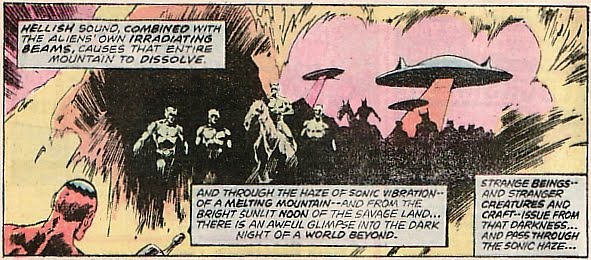
Happily, Ka-Zar's just such a peer and, as such, can do all the damage he wants without having to worry about anyone ever trying to stop him or even asking if he has a license for that sabre-tooth tiger. He's just had a fight with Klaw, master of sound, in the Imperial War Museum, now he has to fight a bright red flying monster Klaw's whipped up with his sonic claw, before jetting off to the Savage Land to head off an alien invasion. It's all a day's work when you're Lord Kevin Plunder.
I love this comic. For reasons I can never put my fingers on, I love Ka-Zar and I love Zabu. I love the Savage/Hidden Land, that not-so-secret realm that can never quite make up its mind what it's called. And, more specifically, this issue I love the pretty pictures.
Subscribe to:
Posts (Atom)