Monday, 17 January 2011

Poll Results: Diablo. Yay or nay?

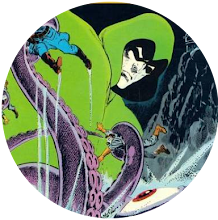
Jack Kirby Fantastic Four #30 Diablo
The results are in for our latest poll...

...and it's a resounding defeat for all haters of the world's greatest alchemist Diablo. Despite Stan Lee's belief that the Fantastic Four villain never caught on, the fiendish pharmacist of felony gained a magnificent seven votes for, "Diablo rocks," and only one vote for, "Diablo sucks." No one voted for, "I am unsure."

Not only that but, after just four days, the original post that prompted the poll (see below) has already become the site's third most viewed article of all time.

As Paul Daniels would have said, "That's Magic!"

And that's Diablo.

Sunday, 16 January 2011

Supergirl in Adventure Comics #391. Linda goes to Hollywood.

Supergirl Adventure Comics #391 Linda Danvers Kurt Schaffenberger
It's the weekend - and that means only one thing.

It's time for Supergirl Sunday!

I could claim I've decided to label it that because it's a great new feature I've thought up but the truth is I'm only saying it because it alliterates and - to me - alliteration is averything.

To Supergirl, keeping her secret identity is everything - which does pose the question as to why, in this issue's first story, she agrees, as Linda Danvers, to star in a Supergirl movie? Won't everyone with a pair of eyes notice that, dressed up as Supergirl, Linda Danvers of Stanhope looks exactly like Supergirl of Stanhope?

Well yes they do but, showing that keen intellect possessed of everyone in Supergirl comics, no one seems to think anything of it.

What's happened is a new-fangled computer in Stanhope College has decreed the ideal career for Linda and her classmate Eve is "actress". Hearing of this, a big film director shows up to make her an offer she can't refuse.

The trouble is that, all through shooting, things go disastrously wrong, A rope snaps, sending Linda plummeting hundreds of feet into a ravine. A giant inflatable whale she's riding bursts, plunging her into shark-infested waters. A gun, that's supposed to fire blanks, fires a real bullet at her. By a whole bunch of unlikely bursts of ingenuity, Linda manages to get through all these mishaps without anyone thinking it odd that she can survive such things unscathed. It all turns out the "accidents" are the handiwork of the studio press agent who's trying to sabotage the film in order to get back at the director for marrying the woman who jilted him. And he would've gotten away with it if not for that pesky Supergirl.

The issue's second tale sees Supergirl go to an alien world, on a foreign exchange trip. What she doesn't know is the student she's supposed to have exchanged with has been kidnapped and replaced by a trouble-maker out to damage Linda Danvers' rep on Earth by leading a student riot back at Stanhope College. I don't think anyone'll be surprised that Supergirl quickly sorts it all out.

Of course, what we really read old Supergirl stories for is their sheer insanity. Sadly, the dementedness levels have been turned substantially down from those of Adventure Comics #390, meaning the only real moments of madness we get are the giant inflatable whale and the fact that the alien planet that Supergirl visits is modelled on Earth, with the town she stays in being an exact replica of Stanhope. But, overall, the comic's good clean fun and the first tale's beautifully drawn by an uncredited Kurt Schaffenberger.

Actually, the most interesting thing for me about this issue - Kurt Schaffenberger aside - is it's one of those months when they print the circulation figures. What strikes me is that, on average, 664,000 copies of Adventure Comics were being printed each month. And there was me assuming Supergirl books just barely limped along.

The other thing that strikes me is that, of those, "only" 354,000 copies were actually sold, with another 309,000 listed as being, "Office Use, Left-Over, Unaccounted," for or just plain, "Spoiled After Printing." Just where were nearly 3.7 million Supergirl comics disappearing to every year?

Saturday, 15 January 2011

Amazing Fantasy #15. Spider-Man's origin.

Marvel Comics Amazing Fantasy #15 Spider-Man origin Stan Lee Steve Ditko Peter Parker
How was I ever not going to love Amazing Fantasy #15? I first read it on Christmas Day, I first read it in Stan Lee's Origins of Marvel Comics and I first read it while eating a genuine imitation-bacon sandwich.

This was the mid-1970s when imitation food was all the rage, and populist science show Tomorrow's World never tired of telling us that by the year 2,000 we'd all be eating nothing but soya beans masquerading as every kind of food imaginable.

Happily they were were wrong and happily there was nothing ersatz about the first-ever appearance of the Amazing Spider-Man. If any debut was the real deal this was it.

The first thing that strikes you reading the tale is that Stan Lee and Steve Ditko seem to have been bitten by a radioactive mongoose before creating it, such is the sheer speed the thing moves at. To give some idea, only just introduced to us, Peter Parker's already got his spider-powers by the end of the second page and has his costume and web-shooters in place by the end of the fifth. It's not surprising therefore that by the end of the tenth page he's had time to use his powers unwisely, made a bucketful of cash, made a huge blunder, and been forced by tragic circumstance to learn the error of his ways.

It's a cleverly constructed thing, tying its strands together beautifully to give us a morality play Aesop himself would've been proud of as, alienated by his treatment by society and therefore thinking only of himself, Spider-Man refuses to prevent a petty crook's escape and then pays the price as that self-same crook goes on to kill his Uncle Ben, one of only two people in the world who ever actually cared about Peter Parker. It's also a nice touch that the cop who breaks the news to Peter that his uncle's dead is clearly the same officer who Spider-Man refused to help apprehend the crook in the first place.

Interestingly, the roles of Spider-Man and Peter Parker are the opposite of what we grew used to in the John Romita years, with Spider-Man hugely popular with a public that can't get enough of his showbiz antics, while Peter Parker - the man who'd one day be fighting off the likes of Gwen Stacy and Mary Jane Watson with a stick - can't even get a girl to look at him. Aunt May, in contrast to later tales, manages to get through the whole issue with not a heart attack in sight. Interesting too to see Flash Thompson at his most brainless.

Given its willingness to delve deeper into human torment and duty than super-hero comics had traditionally done, it's not a surprise that the strip went on to be such a success. The tactic of robbing its central character of a parental figure must also have chimed strongly with the deep-rooted psychological impulses of a readership that was young and therefore at its most dependent on such figures. It was hardly a new thing for a super-hero to lose a guardian - Superman and Batman had both lost their parents in childhood - but had the turmoil of such an event ever been flung in the reader's face in such a stark and cruel manner?

So of course it's an instant classic - though you do have to ask serious questions of those scientists who were ultimately behind all this; the ones who were conducting radiation experiments in front of a totally unprotected public. Maybe those scientists too needed their own reminder that with great power comes great responsibility.

Friday, 14 January 2011

Midnight Tales #8. Arachne & the Midnight Philosopher in, "Amnesia."

Charlton Comics Midnight Tales 8 Arachne and Professor Coffin
With their not-quite-glossy covers, serrated page edges and artwork that didn't always line-up properly with the paper they were printed on, you didn't have to be Sherlock Holmes to notice that Charlton Comics were put together a fair bit more cheaply than the likes of Marvel and DC. But that was a large part of their charm. Everyone, after all, loves an underdog, and few comic companies felt underdoggier than Charlton.

Bearing in mind that a couple of years ago, I bought a bunch of Charlton comics and was somewhat disappointed by them, I didn't exactly have high hopes when, a few days ago, I bought two issues of Midnight Tales. I remembered them with affection but, then again, I'd remembered the likes of Ghostly Haunts and Dr Graves with affection and they'd done nothing for me upon adult re-reading.

Happily, Midnight Tales is the comic that bucked the trend because I really enjoyed both mags. You'd be hard pressed to call their contents spine-tingling because that clearly wasn't the aim. Midnight Tales, with its anchor characters of Professor Coffin and his niece Arachne was patently meant to divert and amuse rather than terrify. I'd say this was a wise decision as, even in the 1970s, there was a limit as to how blood-curdling you could be if you wanted to retain that Comics Code stamp.

So, instead, Midnight Tales #8, sees Charlton ever-present Nicola Cuti giving us a framing story as, called to an isolated island by their friend Charlie, Arachne and the Professor try to discover the identity of a mysterious young woman he's found himself saddled with. As the girl doesn't remember who she is, Charlie's named her Amnesia and, as they try to work out just where she came from, we're given clues via a trio of short stories.

The first involves a Scottish fishing village whose inhabitants set out to destroy a sea monster that's eating all the fish stocks - only to discover why killing the thing wasn't such a good idea after all. The twist doesn't really stand up to scrutiny but it's oddly pleasing and the thing's strikingly drawn by Tom Sutton.

The second tale concerns a man whose obsessive quest to find Atlantis causes him to neglect his wife, leading to disaster for all concerned.

Finally we get the tale of two ne'er do wells who steal what seems to be a giant pearl from a sunken city, only to attract the wrath of the "pearl's" rightful owners.

Now that these stories have been told, we at last get the revelation as to who Amnesia is and what she's doing there.

The nature of Amnesia isn't exactly what you'd call a shock, bearing in mind the watery nature of all these tales and that she was found, "on the rocks," but the reason she's there's a nice touch and adds to the air of affability of it all. The real genius of the comic is the use of Coffin and Arachne as the framing device. Unlike the framing characters of DC's horror mags, they aren't narrators as such, more investigators, and they each have a defined personality, with the always reasonable Coffin and the somewhat tactless Arachne.

Reading these two comics has genuinely made me want to go out and get all the other issues of Midnight Tales. Sadly that's not going to be a Herculean feat, as there aren't that many of them. The title lasted just eighteen issues before the plug was pulled, proving there's no justice in the world. But, with a Hollywood seemingly scraping the bottom of every comic book barrel it can find, for inspiration, I demand it raises its sights and gives us a Professor Coffin and Arachne movie. Knowing the huge weight this blog carries in such quarters, I have no doubt I'll get my wish.


Potential further reading: 

Thursday, 13 January 2011

Diablo. Devilish dues for the attitudinal alchemist.

Fantastic Four #30, Diablo's first appearance and origin
Sometimes it takes your greatest heroes to let you down the most in life and, for some of us, none are greater than Stan Lee. One of the biggest - but I must confess least life-changing - setbacks I've ever experienced was when, during a TV interview a few years back, I saw Stan being asked if he'd ever come up with a super-villain who hadn't worked.

Like any sane man I of course expected him to fling out the name of one of the many inept foes Daredevil or Iron Man had come up against in their early days. Let's be honest, whose heart really chills to the thought of the Purple Man, Leapfrog or even the original Scarecrow who Iron Man had so much difficulty defeating because said villain was helped by a pair of crows? You can see instantly why a man in high-tech battle armour that allows him to tangle with the Hulk would have so much trouble tackling a man with two pet birds.

Instead, Stan produced what for me was the most unexpected name of them all.

Diablo.

How could this be true? Diablo was and still is one of my favourite Fantastic Four villains. In fact, take away Dr Doom and Annihilus, and Diablo goes straight to the top of my list. He was sneaky. He was devious. He had a castle.

For anyone unfamiliar with him, Diablo made his debut in Fantastic Four #30 where, rescued from a giant cork, he set about using his powers of alchemy to amass a vast fortune so he could hire an army and take over the world. While he was at it, he managed the admittedly not rare feat of turning the Thing against his fellow FF members, before a clearly jealous Reed Richards exposed him as a fraud whose potions only worked for a short spell.

After such embarrassment, and having yet again been defeated by a giant cork, a lesser villain would never again have seen the light of day.

But Diablo was no lesser villain and he reappeared, months later, to give life to the Dragon Man for no good reason at all before he and his creation fell into a frozen lake, never to be seen again.

When I say, "Never to be seen again," I of course mean it in the old comic book sense of, "Disappeared for a little bit before reappearing." I recall he later turned up in The Avengers #41 where he seemed to have forgotten he was an alchemist and, judging by his sudden fondness for doing things with disks, seemed to think he'd turned into the Wizard. Frankly, in this appearance he bore little resemblance to the man some of us had known and admired.

Thankfully, by Fantastic Four issue #118, he was back to his old self and hatching a vile plot that involved hypnotising the lovely Crystal into thinking she was on his side so he could take over one of those Latin American countries you can never find on any map. What happened to him after this, I have no idea as I don't recall him ever putting in another appearance in any of the comics I ever read but I like to think he was still out there, still hatching his schemes, ready for the day when he could again return to wreak more pointless havoc on an unsuspecting human race.

Diablo never had any reason for doing the things he did and his greatest enemy was a giant cork. These facts alone would've been enough to endear him to all super-villain fans.

But there was more.

Diablo had one more asset up his sleeve.

He had a great moustache.

Now, a great moustache might not seem like a make-or-break thing for a super-villain but the truth is that villains with moustaches were thin on the ground in the Marvel Comics I read as a kid. The Leader had one but it was so weedy you could only assume he'd grown it purely to prove he could. The Stranger had one but, aww, who ever cared about the Stranger? The Miracle Man had one and, like Diablo, was treated with a disgraceful lack of respect by his foes.

So, for his love of doing evil purely for the sake of doing evil, his fear of giant corks, and his big moustache, in my book, Diablo is one of Marvel's all-time great villains and I'll fight to the death anyone who says otherwise. Unless of course that anyone is Stan Lee. At the age of 88 he might still be young enough to beat me and, like any good super-villain, I have little stomach for defeat.


PS. Today's clearly fated to be Diablo Day because the latest instalment of the Internet's greatest quiz - The Department of Pointless Questions - involves an issue of the Fantastic Four that the aggro-loving alchemist loomed over like a colossus. Remember; you can't win if you don't enter.

The Department of Pointless Questions. Fantastic Four #118.

Fantastic Four #118, Crystal and Diablo
As you'll see from other post of today, I'm in a Diablo state of mind. And that inevitably brings us to The Fantastic Four issue #118. It's a comic I have a lot of affection for, mostly because, as part of Marvel's short-lived move to longer comics, it features not one but two stories.

Not only that but its interior contains both Diablo and Crystal of the Inhumans, with Crystal in particular looking rather fetching in the guise of a fake goddess.

But, it strikes my eyeballs that there's an anatomical error with one of the characters on this cover. So, can you spot what it is?

As always the winner gets a great big Steve Does Comics No-Prize.

Remember, no ordinary blog hands out such awards - probably because no ordinary blog's so cheap and mean-spirited - so it's a non-prize you simply won't be able to get anywhere else.

Wednesday, 12 January 2011

Avengers #92. The Kree/Skrull War Part 4.

Avengers #92, the Kree/Skrull War, Neal Adams
What with interplanetary war on the brink of breaking out, there're many things to be concerned about in The Avengers #92 but possibly the most disturbing of them all is that the comic kicks off with Quicksilver cracking jokes and the Vision dressed like he's about to burst into a bunch of Perry Como songs. Presumably this attempt to show the pair in a more relaxed state than we're used to is an attempt by Roy Thomas and Sal Buscema to humanise our not always warm and cuddly duo but it feels more like we've fallen into an alternate world and I hope I never again have to endure the sight of the Vision in fireside crooner mode.

Then again, maybe they've been replaced by Skrulls.

Thanks to the blabbing scientists rescued from Ronan last issue, Senator H Warren Craddock certainly thinks there's something afoot with the Avengers as he demands they hand over Captain Marvel and then attend a hearing into un-Earthian activities, while he simultaneously whips the American public into a frenzy about the threat of aliens amongst us. It's easy to see the public here as a bunch of hysterical idiots - and that's presumably how we're meant to see them - but in fairness, if, in the real world it came to light that a group of self-appointed people had been keeping information of an alien menace from us, I suspect most of us would be a little miffed and distrustful.

As for Craddock and his commission, the parallels with Joe McCarthy are not exactly subtly presented but there's nothing like a foaming-at-the-mouth bigot to ramp up the dramatic tension and remind you just who the good guys and bad guys are. The one thing that does jar in the sequence at the hearing is the behaviour of the Thing, where he drops the Avengers in it, big-time, by making it clear he doesn't trust them not to be traitors to Earth. I know Aunt Petunia's favourite nephew isn't always the most diplomatic of souls but you'd expect him to have some sort of sense.

Captain Marvel meanwhile's done a runner, having been offered a farm house hiding place by Carol Danvers whose arrival by helicopter crash should've flattened the Avengers Mansion but barely put a dent in its roof. Interesting that, after Mar-Vell leaves, Rick Jones has a scene where he starts to think about the super-heroes he used to read about in the comic books of his youth, suggesting that Roy Thomas had, even at this early stage, worked out how the whole thing was going to end. Judging by his determination to keep using him in various comics, it seems Thomas always had a soft spot for Jones, possibly seeing the super-hero wannabe as a natural representative of the reader, but does this redefining of Jones as a comic book obsessive mean that keen comic book historian Thomas is projecting himself and his own interests through him?

Of course, despite rampaging mobs, one-sided hearings and helicopter crashes, the real drama of the issue comes at its very end as Thor, Captain America and Iron Man show up and, unhappy at the way the current line-up have handled the situation, disband the Avengers. How can our heroes get out of this hole? Well, I suppose they could just form their own super-hero team and carry on regardless.

But will they?